
Where to Put Carbon Monoxide Detectors: Bedrooms, Each Level, Furnace, Garage
Where to put carbon monoxide detectors, how many you need and how high to mount them, from NFPA, CPSC, the building code and the alarm makers' manuals.
Affiliate disclosure: product links on this page go to Amazon, to Sylvane (a US air-quality retailer), or to the maker's own store for brands that sell only direct. As an Amazon Associate we earn from qualifying purchases, and Sylvane pays us a commission on sales made from our links through the CJ (Commission Junction) affiliate network, at no extra cost to you; a link to a maker's store earns us nothing. No retailer or brand sees our picks before they are published or has any say in them. How we choose.
Put a carbon monoxide detector outside each sleeping area and on every level of the home, at the height its own manual gives. The National Fire Protection Association (NFPA) says to "follow the manufacturer's instructions for placement and mounting height", and the Consumer Product Safety Commission (CPSC) allows a plug-in outlet or a spot high on the wall. Keep it out of the kitchen, garage and furnace room: at least 6 feet from fuel-burning appliances by Kidde's manuals, or 20 feet from a furnace or water heater by First Alert's. If a bedroom or its attached bathroom has a fuel-burning appliance, the 2021 International Residential Code (IRC) wants an alarm inside that bedroom too.
Below, the rules from NFPA, CPSC, EPA, the building code and the Kidde and First Alert manuals sit side by side, followed by the questions they leave open: how high, how many, and the basement and garage. Which alarm suits each spot is in our best carbon monoxide detectors guide.
Carbon monoxide detector placement rules, side by side
Every source agrees on the core of carbon monoxide detector placement: one alarm near the bedrooms and one on each level. They part ways on the details. A blank cell means that document does not address the point; height, appliance distances and the garage each get their own section below.
| Question | NFPA and CPSC | 2021 IRC | Kidde guides | First Alert CO710 manual |
|---|---|---|---|---|
| Near bedrooms | NFPA: a central location outside each sleeping area. CPSC: outside sleeping areas | Outside each separate sleeping area, in the immediate vicinity of the bedrooms | Outside of sleeping areas | Near or within each separate sleeping area |
| Every level | Both say every level | Not in the model text; some states add it | Each level, ideally any level with fuel-burning appliances | Each level "for added protection" |
| Inside a bedroom | When a fuel-burning appliance is in the bedroom or its attached bathroom | In each bedroom when doors are usually closed at night | ||
| Basement | CPSC: not unless it includes a sleeping area. NFPA: every level | At the top of the basement stairs | ||
| Bathrooms and humidity | At least 3 ft from the door of a bathroom with a tub or shower | At least 10 ft from a bath, shower, humidifier, vaporizer, dishwasher or laundry room | ||
| Airflow | CPSC: not near heating vents or where furniture or drapes cover it | At least 3 ft from supply ducts and ceiling or whole-house fans | Away from ceiling fans, heat vents, air conditioners, returns and open windows |
Why the manual wins: UL 2034, the US standard for home CO alarms, requires each maker's instructions to show appropriate locations and list the places where installation is not appropriate. EPA tells readers to follow those instructions "exactly".
How high should a carbon monoxide detector be?
No single height is right for every carbon monoxide detector. NFPA defers to the maker, and CPSC allows a plug-in outlet or a spot high on the wall. Neither agency says to mount it low because CO is heavy, or on the ceiling because it rises.
The NIOSH Pocket Guide gives carbon monoxide a relative gas density of 0.97, where air is 1. Our reading: CO weighs almost what air does, so it does not sink like propane or rise like natural gas, and the model's own mounting rule is the one to follow. Kidde says a tabletop alarm should sit no more than 3 feet up, but "the alarm does not have to be within three feet from the floor to detect CO"; the limit is there so a fall is less likely to damage it.
| Alarm type (example) | Where the maker says it goes | Source |
|---|---|---|
| Plug-in (Kidde COPD) | A standard 120 V outlet that no wall switch or dimmer controls | Kidde plug-in guide |
| CO plus explosive gas, on a cord (Kidde COPDLG) | High on the wall, no closer than 6 in to the ceiling, for natural gas; near the floor for propane | Kidde plug-in guide |
| Battery (Kidde COBD10) | On a wall, or on a table no more than 3 ft from the floor | Kidde battery guide |
| Battery (First Alert CO710) | On a wall no closer than 4 in (102 mm) to where the wall meets the ceiling, or on a table no more than 3 ft up | First Alert CO710 manual |
| Smoke and CO combo (Kidde 30CUD10-V) | Ceiling preferred; on a wall, top edge no more than 12 in below the ceiling | Kidde smoke and combo guide |
The combo is the exception. A smoke and CO combination alarm has to go where its smoke sensor works, and Kidde's guide says smoke rises to the ceiling, so ceiling mounting is preferred. At any height, avoid dead air: Kidde rules out the peaks of vaulted ceilings and gabled roofs, where CO may not reach the sensor in time.
How many carbon monoxide detectors do I need?
Most homes need one carbon monoxide detector outside each separate sleeping area plus one on every other level, by NFPA's and CPSC's wording. Add one inside any bedroom with a fuel-burning appliance, one at each end of a bedroom hallway longer than 40 feet (First Alert), and one in each bedroom if the doors stay shut at night. The table applies those rules; these are our worked examples, not a code reading for your town.
| Home | Minimum by NFPA and CPSC wording | What the makers add |
|---|---|---|
| One story, bedrooms off one hallway, gas furnace in a utility closet | 1, in the bedroom hallway | First Alert: 1 more on that level, at least 20 ft from the furnace |
| Two stories, bedrooms upstairs, basement with the furnace | 3: upstairs hallway, main floor, basement (CPSC counts the basement only if someone sleeps there) | First Alert: the basement alarm at the top of the stairs |
| Bedroom with a gas fireplace in it | 2: one inside that bedroom (2021 IRC, new homes) and one outside the sleeping area | Interconnect them (NFPA) |
All-electric homes count too. The 2021 IRC requires alarms in new homes only where there is a fuel-fired appliance or an attached garage that opens into the home, but CPSC's advice has no such condition, and Kidde lists a car idling in an attached garage or near a home among CO sources.
Kidde warns that an alarm outside the bedroom or on another floor "may not wake up a sound sleeper", so NFPA says to interconnect all CO alarms: when one sounds, they all sound. The 2021 IRC requires interconnection in new homes that need more than one alarm and accepts listed wireless alarms. For wired interconnection, our pick is the Kidde 30CUA10; for a hallway outlet on each level, the Kidde COPD.
Near the furnace, water heater and gas stove
A carbon monoxide detector for the furnace or gas stove belongs on the same level as the appliance, but not beside it. The makers disagree on the distance, so check the manual for the alarm you own.
| Appliance | Kidde | First Alert | Standard and agency |
|---|---|---|---|
| Furnace, boiler or water heater | At least 6 ft | At least 20 ft; never in the furnace room | CPSC: not above fuel-burning appliances |
| Gas range or cooktop | At least 6 ft | At least 5 ft; never in the kitchen | UL 2034: not within 5 ft of any cooking appliance. CPSC: not in kitchens |
That means the hallway next to the furnace room rather than its wall, and the hall outside the kitchen rather than above the range. In a small home where 20 feet is impossible, a Kidde alarm's 6-foot rule may be the one you can meet.
A CO alarm does not detect a gas leak. Kidde's guide puts explosive gas alarms where fuel-burning appliances are: kitchens, basements, laundry rooms and near gas fireplaces. The Kidde COPDLG does both jobs; its data sheet lists UL 2034 for CO and UL 1484 for gas, a cord so it can hang high for natural gas or low for propane, and a 7-year life rather than 10.
Garages, basements, crawl spaces and attics
Garage
Do not put a household carbon monoxide detector inside the garage. Kidde lists it first among locations to avoid because "products of combustion are present when you start your automobile", First Alert says the same, and both limit their alarms to 40 to 100°F, a range an unheated garage can leave. UL 2034 has extra tests for alarms meant for "unconditioned areas such as garages, attics, and the like", so an alarm belongs there only if its manual says so.
First Alert suggests mounting the detector inside the home near the door from the garage. Kidde's guides say not near doors, so use a wall in the room inside rather than the door frame. An attached garage that opens into the home is one of the two triggers for CO alarms in new homes under the 2021 IRC. A purifier will not remove exhaust, as our garage air purifier guide explains.
Basement
This is where the sources disagree. CPSC says CO alarms should not go in basements "unless they include a sleeping area". NFPA says every level, EPA says "each floor of the home needs a separate detector", and First Alert puts the basement alarm at the top of the basement stairs. Our reading: a basement with the furnace and water heater is a "level with fuel burning appliances" in Kidde's words, so mount one at the top of the stairs, at the distances above from the appliances and within 40 to 100°F.
Crawl spaces and attics
Both makers rule out crawl spaces and unfinished attics because they can fall below 40°F or rise above 100°F. Protect the floor above instead.
Bedrooms and nurseries
A carbon monoxide detector goes inside a bedroom in two cases. The 2021 IRC requires one when a fuel-burning appliance, such as a gas fireplace, is in the bedroom or its attached bathroom. First Alert recommends one in each bedroom, plus one in the hallway between them, when bedroom doors are usually closed at night, because doors slow the rate at which CO reaches the sensor.
Kidde and First Alert both allow a battery alarm on a dresser or nightstand no more than 3 feet off the floor. EPA's test for a home with only one detector: put it near the sleeping areas and make sure it is loud enough to wake you.
Mind the humidifier. First Alert wants its alarm at least 10 feet from a humidifier or vaporizer, and Kidde says very humid air can cause nuisance alarms. If a bedroom humidifier runs on the nightstand, put the CO alarm across the room.
Apartments, rentals and mobile homes
In an apartment, the carbon monoxide detector goes inside your own unit by the same rules: outside the bedrooms, and on each level of the unit. First Alert's older CO400 manual says its alarm is not meant for the common lobbies, hallways or basements of multi-family buildings unless each unit also has one, because alarms in common areas may not be heard inside the units. Who supplies it depends on the state: NCSL's summary shows California requiring owners of single-family dwellings and hotel and motel units to maintain one. A plug-in suits a renter who cannot drill.
In a mobile home, First Alert says to mount alarms on inside walls only, because uninsulated outside walls and roofs carry heat and cold; its CO400 manual adds 6 inches from exterior walls and 12 inches from supply or return vents. Neither brand's alarms here are designed for RVs or boats.
What state law can add
States amend the model code. NCSL tracks the laws: triggers include new construction, sale, renovation and rental, typically where a home has a fossil-fuel appliance, a fireplace or an attached garage.
| State | Placement rule |
|---|---|
| Florida (new construction) | Within 10 ft of each room used for sleeping |
| Illinois | Within 15 ft of every room used for sleeping |
| Minnesota (residential code) | Not more than 10 ft from each separate sleeping area or bedroom, and on each level with sleeping areas |
| Washington (residential code) | Outside each separate sleeping area, on each level, and per the maker's recommendations |
A hallway alarm within 10 feet of every bedroom door meets each distance rule in this table. Work that needs a permit should be checked with the local building department.
After you mount it
- Test it. NFPA says at least monthly; CPSC says test monthly and change batteries yearly. The Kidde and First Alert manuals, and EPA for battery units, say weekly. CPSC notes the button tests the circuitry, not the sensor's accuracy.
- Write the replace-by date on it. Kidde: 10 years from first power-up for CO alarms, 7 for CO and gas alarms.
- Label the fresh-air spot. Both makers supply a pair of labels: one near the alarm, one where you plan to gather if it sounds.
Looking for a "CO2 detector"? Carbon dioxide monitors measure ventilation and follow other rules; see where to place an air quality monitor and our best CO2 monitors. CO is one of the two hazards in our guide to measuring indoor air quality that need their own device. A low-level monitor kept beside a listed alarm follows its own manual's distances; see our best low-level carbon monoxide monitors.
Frequently asked questions
Where is the best place to put a carbon monoxide detector?
Outside each sleeping area and on every level of the home, as NFPA and CPSC advise, at the height the alarm's manual gives. Keep it out of the kitchen, garage and furnace room, at least 6 feet from fuel-burning appliances by Kidde's manuals or 20 feet from a furnace or water heater by First Alert's.
How high should a carbon monoxide detector be mounted?
There is no single height. NFPA says to follow the maker's instructions, and CPSC says a plug-in outlet or high on the wall both work. Kidde and First Alert battery alarms can hang on a wall or sit on a table no more than 3 feet up (the CO710 not within 4 inches of the ceiling), while smoke and CO combos go on the ceiling or high on the wall.
How many carbon monoxide detectors do I need?
At least one outside each separate sleeping area and one on every other level. Add one inside any bedroom with a fuel-burning appliance (the 2021 IRC rule for new homes), one at each end of a bedroom hallway longer than 40 feet, and one in each bedroom if doors are closed at night, as First Alert recommends.
Should I put a carbon monoxide detector in my bedroom?
Yes if a fuel-burning appliance such as a gas fireplace is in the bedroom or its attached bathroom, which the 2021 IRC requires for new homes. First Alert also recommends one in each bedroom when doors are usually closed at night. Keep it at least 10 feet from a humidifier, per First Alert's manual.
How far should a carbon monoxide detector be from a furnace or gas stove?
Kidde says at least 6 feet from heating or cooking appliances. First Alert says at least 20 feet from a furnace or water heater and 5 feet from cooking appliances, and never in the furnace room or kitchen. UL 2034 requires every maker's instructions to say not within 5 feet of a cooking appliance.
Can you put a carbon monoxide detector in the garage?
Not a household alarm. Kidde and First Alert both list the garage as a place to avoid, because exhaust is present when you start a car and the temperature can leave their 40 to 100°F range. Put one inside the home on the garage side instead, unless an alarm's own manual says it is made for garages.
Do I need a carbon monoxide detector in the basement?
Sources differ. CPSC says not in basements unless someone sleeps there, while NFPA says every level, EPA says each floor, and First Alert puts the basement alarm at the top of the basement stairs. If the furnace or water heater is down there, an alarm at the top of the stairs follows the makers' advice.
Sources
- Carbon Monoxide Safety (safety tip sheet), National Fire Protection Association
- Carbon Monoxide Questions and Answers, US Consumer Product Safety Commission
- CO Alarms, US Consumer Product Safety Commission
- Where should I place a carbon monoxide detector?, US Environmental Protection Agency
- Carbon Monoxide Alarm Requirements (reprints 2021 IRC Section R315), Harford County, Maryland
- Battery Powered Carbon Monoxide Alarms: User Guide (G-000069-00), Kidde
- AC Plug-In Carbon Monoxide Alarms: User Guide (G-000068-00), Kidde
- CO710 Carbon Monoxide Alarm User's Manual (M08-0534, Rev B), First Alert (BRK Brands)
- Carbon Monoxide Detector Requirements, Laws and Regulations, National Conference of State Legislatures
- NIOSH Pocket Guide to Chemical Hazards: Carbon monoxide, CDC, National Institute for Occupational Safety and Health
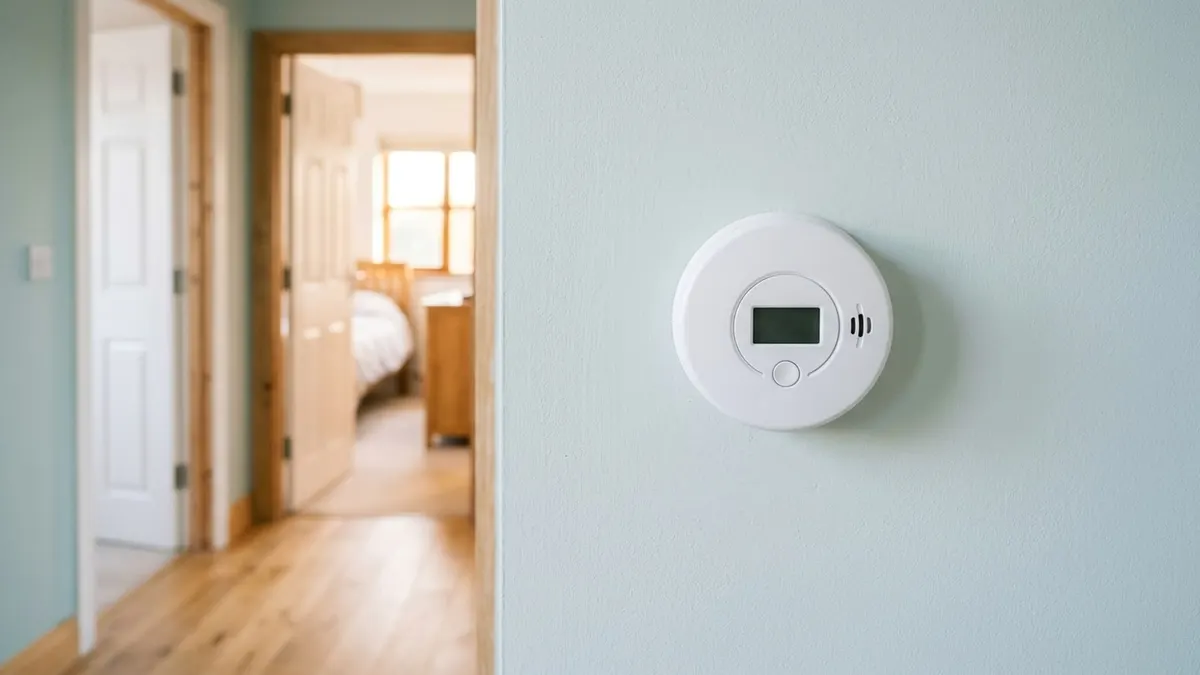
Cover image: Illustration: Indoor Air Review (AI-generated)
Related guides
Best Low-Level Carbon Monoxide Monitors: Readings Below the UL 2034 Alarm
Standard CO alarms show nothing below 30 ppm. These picks warn sooner: a listed Kidde alarm with a 30 to 70 ppm alert, a meter that reads from 0 and one whose low alarm you can set to 5 ppm.
Best Carbon Monoxide Detectors of 2026: Plug-In, 10-Year, Combo and Smart
Seven CO alarms chosen on their data sheets: power that survives an outage, display and peak memory, replace-by date and interconnect, all listed to UL 2034.

Air Quality Monitor for a Nursery: What to Track and Which to Choose
A nursery monitor is most useful for temperature, humidity and ventilation, with PM2.5 as a bonus. It does not replace a smoke or CO alarm. Here is what to track and what to buy.