
Best Carbon Monoxide Detectors of 2026: Plug-In, 10-Year, Combo and Smart
The best carbon monoxide detector for each spot in a home: plug-in, 10-year sealed, combo, hardwired and smart CO alarms, checked against UL 2034 and CPSC advice.
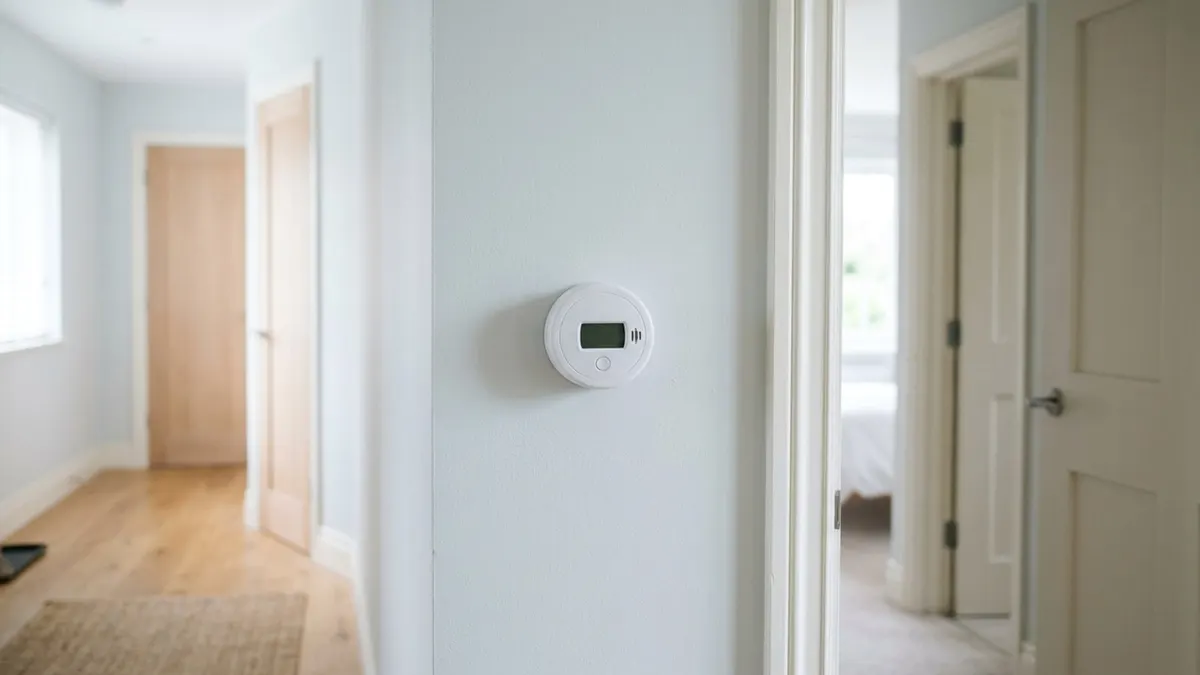
Affiliate disclosure: product links on this page go to Amazon, or to the maker's own store for brands that sell only direct. As an Amazon Associate we earn from qualifying purchases, at no extra cost to you; a link to a maker's store earns us nothing. No retailer or brand sees our picks before they are published or has any say in them. How we choose.
The best carbon monoxide detector for most homes is the Kidde COBD10. A sealed battery runs it for 10 years, so it keeps working in a power cut and never needs a battery change. Its backlit display has a Peak Level button that shows the highest CO level it has recorded, from 31 to 999 ppm. It hangs on a wall or stands on a table, and it chirps when its 10 years are up.
This guide is for anyone fitting CO alarms after a move, a new gas appliance or a chirping old unit. Beyond the top pick it covers a plug-in with a display, a budget battery alarm, a bedside unit, two smoke and CO combos (one battery, one hardwired and interconnected) and a smart alarm. Every pick is listed by a testing laboratory to UL 2034, the US standard for home CO alarms. We chose them on the makers' data sheets and user guides: power source, display and memory, replace-by date and interconnect.
Our top picks at a glance
1. Best overall
Kidde COBD10 10-Year Battery CO Alarm with Digital DisplayPower: 10-year sealed battery · Display: Backlit; peak memory 31 to 999 ppm · Replace after: 10 years (end-of-life chirps) · Interconnect: None
2. Best plug-in
Kidde COPD Plug-In CO Alarm with AA Backup and Digital DisplayPower: 120V plug-in, 2 AA backup · Display: Backlit; peak memory 31 to 999 ppm · Replace after: 10 years · Interconnect: None
3. Best budget
Kidde COB AA Battery CO AlarmPower: 2 AA batteries · Display: None (status lights) · Replace after: 10 years · Interconnect: None
4. Best for a nightstand
First Alert CO710 10-Year Battery CO Alarm with Digital DisplayPower: 10-year sealed lithium cell · Display: CO level, peak memory, room temperature · Replace after: 120 months · Interconnect: None
5. Best smoke and CO combo
Kidde 30CUD10 Smoke + CO Alarm, 10-Year BatteryPower: 10-year sealed battery · Display: None (status lights) · Replace after: 10 years · Interconnect: None
6. Best hardwired, interconnected
Kidde 30CUA10 Hardwired Smoke + CO Alarm, 10-Year BackupPower: 120V hardwired, 10-year backup · Display: None (status lights) · Replace after: 10 years · Interconnect: Wired, up to 24 Kidde devices
7. Best smart
Kidde COPDLQW Smart CO Alarm with Indoor Air Quality MonitorPower: 120V plug-in, 2 AA backup · Display: Backlit digital · Replace after: 10 years · Interconnect: None (app alerts only)
| Pick | Power | Display | Replace after | Interconnect | Buy |
|---|---|---|---|---|---|
| Kidde COBD10 10-Year Battery CO Alarm with Digital DisplayBest overall | 10-year sealed battery | Backlit; peak memory 31 to 999 ppm | 10 years (end-of-life chirps) | None | Amazon |
| Kidde COPD Plug-In CO Alarm with AA Backup and Digital DisplayBest plug-in | 120V plug-in, 2 AA backup | Backlit; peak memory 31 to 999 ppm | 10 years | None | Amazon |
| Kidde COB AA Battery CO AlarmBest budget | 2 AA batteries | None (status lights) | 10 years | None | Amazon |
| First Alert CO710 10-Year Battery CO Alarm with Digital DisplayBest for a nightstand | 10-year sealed lithium cell | CO level, peak memory, room temperature | 120 months | None | Amazon |
| Kidde 30CUD10 Smoke + CO Alarm, 10-Year BatteryBest smoke and CO combo | 10-year sealed battery | None (status lights) | 10 years | None | Amazon |
| Kidde 30CUA10 Hardwired Smoke + CO Alarm, 10-Year BackupBest hardwired, interconnected | 120V hardwired, 10-year backup | None (status lights) | 10 years | Wired, up to 24 Kidde devices | Amazon |
| Kidde COPDLQW Smart CO Alarm with Indoor Air Quality MonitorBest smart | 120V plug-in, 2 AA backup | Backlit digital | 10 years | None (app alerts only) | Amazon |
Best overall
Kidde COBD10 10-Year Battery CO Alarm with Digital Display
For the hallway outside the bedrooms and every level of most homes: 10 years on a sealed battery, a backlit display and peak-level memory.
- Power
- 10-year sealed battery
- Display
- Backlit; peak memory 31 to 999 ppm
- Replace after
- 10 years (end-of-life chirps)
- Interconnect
- None
Pros
- No battery changes for 10 years, and it keeps working in a power cut
- Peak Level button shows the highest CO it has detected
- Holds low-battery chirps until daytime, per Kidde
Cons
- Not interconnected: it sounds only where the CO reaches it
- 40 to 100°F operating range rules out garages and unheated spaces
The COBD10 is Kidde's 2026 Detect-series model with a display, and the Amazon listing says it replaces the older C3010D. Kidde's data sheet lists an electrochemical sensor, an 85 dB alarm at 10 feet, an operating range of 40 to 100°F at 10 to 95% humidity, and a 10-year limited warranty that includes the battery. It measures 5.14 by 2.83 inches and weighs 0.28 lb. On a table, Kidde's guide asks you to keep it no more than three feet off the floor, where a fall is less likely to damage it.
The display earns its place after the fact. After an alarm, a red light blinks twice every 15 seconds for up to 7 days. Once the alarm has seen 100 ppm or more, the Peak Level button shows the highest reading, from 31 to 999 ppm, which tells you and the technician what happened while you were out. Like every UL 2034 alarm, it shows no number at all below 30 ppm (see the alarm points below).
Skip it if your alarms need to sound together: the hardwired Kidde 30CUA10 below does that. If someone at home has a heart or lung condition, the Kidde COBDL10 is the same alarm with a Low Level CO Alert, which Kidde's guide places between 30 and 70 ppm.
Best plug-in
Kidde COPD Plug-In CO Alarm with AA Backup and Digital Display
For a free outlet on each level: the same display and peak memory as the top pick, running on house power with two AA batteries for short outages.
- Power
- 120V plug-in, 2 AA backup
- Display
- Backlit; peak memory 31 to 999 ppm
- Replace after
- 10 years
- Interconnect
- None
Pros
- Rotating plug turns 90° to sit upright in most outlets
- Backup batteries keep it working through short outages
- Kidde says it can travel to hotels and rentals (not RVs or boats)
Cons
- Kidde says not to use lithium AA batteries in it
- Not for an outlet controlled by a wall switch or dimmer
The COPD is the plug-in sibling of the top pick. Kidde's data sheet lists 120 V AC at 30 mA with two AA backup batteries, an electrochemical sensor, 85 dB at 10 feet, a 40 to 100°F range and a 10-year limited warranty (batteries excluded). It reminds you to replace it 10 years after it is first powered.
Two rules from Kidde's plug-in user guide matter. Use a standard 120 V outlet that no wall switch or dimmer controls, and use alkaline AA cells only: Kidde names the Energizer E91 and says lithium batteries should not be used. Kidde describes the backup as temporary power for short-term outages, so where the power goes out for days, the sealed-battery COBD10 is the better fit.
This is also our answer to searches for the Kidde Nighthawk. Several of Kidde's older KN-series alarms carry the Nighthawk name, and Kidde still lists the KN-COPP-3, a plug-in with a display and a 9 V backup battery, on its site. Amazon stock of it was scarce when we checked. The COPD is the newer model we would buy instead.
Best budget
Kidde COB AA Battery CO Alarm
The lowest-cost way to put a listed CO alarm on an extra level: two AA batteries and no display, with the same sensor, horn and 10-year life.
- Power
- 2 AA batteries
- Display
- None (status lights)
- Replace after
- 10 years
- Interconnect
- None
Pros
- Same electrochemical sensor and 85 dB horn as the dearer models
- Wall or tabletop: nothing to wire or plug in
- Lowest Kidde list price on this page
Cons
- No display or peak memory, only a light that shows CO was detected
- AA batteries to replace; CPSC advises every year
The COB is the plain version of the line. Kidde's data sheet lists two AA batteries, an electrochemical sensor, 85 dB at 10 feet, a 40 to 100°F range and a 10-year limited warranty (batteries excluded), with end-of-life beeps 10 years after it is powered. A red light blinks twice every 15 seconds after it has detected CO, but with no screen you will not know how high the level went. Kidde lists the COB at $26.97 on its own site, against $52.97 for the COBD10 (prices change).
That is enough for a second or third level, or a basement with a bedroom in it, where the job is to wake people up. CPSC advises replacing alarm batteries every year and testing alarms monthly; Kidde's guide asks for a test every week. For the main hallway, the COBD10 adds the readings and drops the battery changes.
Best for a nightstand
First Alert CO710 10-Year Battery CO Alarm with Digital Display
A low, wide 10-year alarm made to sit on a dresser or bedside table, with a display that stays dark unless it is tested or alarming.
- Power
- 10-year sealed lithium cell
- Display
- CO level, peak memory, room temperature
- Replace after
- 120 months
- Interconnect
- None
Pros
- Backlight comes on only when tested or in alarm, so it stays dark at night
- Shows room temperature in standby
- Sealed power cell: nothing to change for 10 years
Cons
- Weighs 4.8 oz, so keep it where it will not get knocked off
- No low-level alert and no interconnect
First Alert's spec sheet describes the CO710 as a sealed 3 V lithium alarm with an electrochemical sensor and an 85 dB horn, listed to UL 2034, measuring 4.75 by 2.63 by 0.94 inches. Its display shows CO levels when it alarms, a Peak Level Memory and, in standby, the room temperature. The backlight comes on only when you press the test button or the unit is in alarm, which suits a bedroom. First Alert says to replace it 120 months after installation, and it chirps at the end of its service life.
First Alert designs it for wall mounting or tabletop placement at 3 feet or less. Use it as an extra alarm inside a bedroom, on top of the one CPSC and NFPA want in the hallway outside the sleeping area. For that hallway spot, the wall-hung Kidde COBD10 fits better.
Best smoke and CO combo
Kidde 30CUD10 Smoke + CO Alarm, 10-Year Battery
One 10-year battery device for a spot that needs both a smoke alarm and a CO alarm, such as the hallway outside the bedrooms.
- Power
- 10-year sealed battery
- Display
- None (status lights)
- Replace after
- 10 years
- Interconnect
- None
Pros
- Photoelectric smoke and electrochemical CO sensors in one device
- Different alarm patterns for fire and for CO
- Kidde says its sensing reduces false alarms from cooking
Cons
- No display, so no CO reading or peak memory
- Not interconnected: see the 30CUA10 if your alarms must sound together
A combination alarm saves a mounting spot and a battery change. Kidde's data sheet lists a photoelectric smoke sensor, an electrochemical CO sensor, a 10-year sealed battery, 85 dB at 10 feet, 5 by 5 by 2 inches, and a 10-year limited warranty that includes the battery. Fire sounds as three long beeps and CO as four quick beeps, and the red light flags any smoke or CO detected in the past 24 hours. The data sheet lists UL 217 for smoke and UL 2034 for CO.
The trade-off is placement. A combo goes on a wall or ceiling in a spot that suits its smoke sensor, following its user guide, while a CO-only alarm can plug into an outlet. Kidde's own data sheet notes that experts recommend both ionization and photoelectric smoke alarms, so one photoelectric combo does not cover every kind of fire. A level without a combo still needs a CO alarm: Kidde recommends one on each level, ideally on any level with fuel-burning appliances.
Best hardwired, interconnected
Kidde 30CUA10 Hardwired Smoke + CO Alarm, 10-Year Backup
For homes wired for linked alarms: AC power with a 10-year backup, and every connected Kidde alarm sounds when one does.
- Power
- 120V hardwired, 10-year backup
- Display
- None (status lights)
- Replace after
- 10 years
- Interconnect
- Wired, up to 24 Kidde devices
Pros
- When one alarm sounds, they all sound
- Sealed 10-year backup battery: no changes
- Plug-in quick connector; fits a single-gang box or up to a 4-inch octagon box
Cons
- Needs house wiring; new wiring is a job for an electrician
- Interconnects only with Kidde devices unless Kidde says otherwise
CPSC puts it plainly: interconnected CO alarms are best, because when one sounds, they all sound. The 30CUA10 is Kidde's smoke and CO combo for that job. Kidde's data sheet lists 120 V AC, 60 Hz, 42 mA maximum, a 10-year sealed backup battery, photoelectric and electrochemical sensors, 85 dB at 10 feet and a 10-year limited warranty. Up to 24 Kidde devices can share one interconnect on up to 1,000 feet of wire, within NFPA's limit of 18 initiating devices (no more than 12 of them smoke alarms) plus 6 strobes or relay modules.
Kidde says to install it to local codes, Article 760 of the National Electrical Code and NFPA 72, on a single continuous power line that no switch controls and no ground fault interrupter protects. Before swapping out existing wired alarms, check the brand: Kidde says this one is not designed to interconnect with other makers' products unless specified, so a home wired with another brand needs a matching set.
Best smart
Kidde COPDLQW Smart CO Alarm with Indoor Air Quality Monitor
For anyone who wants a phone alert when they are away, plus early low-level CO alerts and basic air quality readings.
- Power
- 120V plug-in, 2 AA backup
- Display
- Backlit digital
- Replace after
- 10 years
- Interconnect
- None (app alerts only)
Pros
- Kidde app alerts over 2.4 GHz Wi-Fi; works with Alexa and Google Home
- Low Level CO Alert at 70 ppm within 21 minutes, ahead of the full alarm
- Adds TVOC and humidity readings (per the Amazon listing)
Cons
- Air quality insights need Kidde's optional Advanced Home Health subscription
- Wi-Fi features stop working without AC power
The COPDLQW is Kidde's smart plug-in. Kidde's data sheet lists 120 V AC at 50 mA with two AA backups, an electrochemical sensor, 85 dB at 10 feet and a 10-year limited warranty (batteries excluded), plus 2.4 GHz Wi-Fi and the Kidde app. It also has the Low Level CO Alert: Kidde lists alert times of 21 minutes at 70 ppm, 9 at 150 and 4 at 400, ahead of the full alarm's UL 2034 windows.
Read Kidde's fine print before paying for the extras. Kidde says its mobile alerts are for information only and "are not intended or suitable for life safety or critical purposes", that they are only as reliable as your Wi-Fi, and that Wi-Fi features do not work without AC power. The air quality side is a bonus, not a monitor to rely on: Kidde says those sensors "are not designed for life safety, and are not OSHA or UL certified", that they can take up to 4 days to reach full accuracy, and that the insights need an optional subscription. For PM2.5 and CO2 readings, see our best air quality monitors.
If you want app alerts without the air quality sensors, Kidde's COPDW is its smart plug-in CO alarm without the air quality monitor.
How we chose carbon monoxide detectors
Every pick had to pass five tests, taken from CPSC and NFPA advice and from the makers' own data sheets and user guides. Every figure on this page comes from those documents or from the UL 2034 standard.
- Listed to UL 2034. CPSC says to install a CO alarm that meets the current UL 2034 standard, and NFPA says to choose one listed by a qualified testing laboratory. Kidde's data sheets list UL 2034 for every Kidde pick (the Amazon listings add that they are ETL listed to the 5th edition), and First Alert lists the CO710 to UL 2034.
- Power that survives an outage. CPSC recommends battery-operated CO alarms or alarms with battery backup, so every plug-in and hardwired pick carries a backup.
- An electrochemical sensor and an 85 dB horn. Every pick names its sensor type, and UL 2034 requires at least 85 decibels at 10 feet.
- A stated service life. Each pick signals when it is due for replacement, and all of them are rated for 10 years.
- Sold by Amazon itself when we checked on Nov 8, 2026, rather than by a third-party seller.
A CO alarm is step two in our guide to measuring indoor air quality at home; the other hazard that needs its own test is radon (see our best radon detectors).
What sets off a carbon monoxide alarm
UL 2034 does not use a single trigger level. It sets a time window for each concentration, based on the exposure that would raise carboxyhemoglobin (CO bound to the blood's hemoglobin) to 10 percent. CPSC staff's September 2026 memo shows the same windows in the current 5th edition.
| CO level | What UL 2034 requires |
|---|---|
| 30 ppm | No alarm for 30 days |
| 70 ppm | Alarm within 60 to 240 minutes (no alarm in the first 60) |
| 150 ppm | Alarm within 10 to 50 minutes |
| 400 ppm | Alarm within 4 to 15 minutes |
Three things follow. First, a listed alarm is built not to sound for a brief exposure; UL Standards & Engagement's example is lighting a gas stove. Second, a display cannot show anything below 30 ppm. UL 2034 says "No indication shall be given for CO concentrations less than 30 ppm", and CPSC staff add that a display must not read 0 either, so a blank screen means under 30 ppm, not none. Third, the standard allows an optional pre-alarm above 30 ppm, which is how Kidde's low-level models give an earlier warning.
UL 2034 also requires the instructions to say that people with medical problems may consider devices that signal CO under 30 ppm, and every Kidde data sheet repeats that line. Those are low-level CO monitors, a separate category from home alarms.
Which type goes where
| Type | Our pick | Works in a power cut | Good spot | Watch for |
|---|---|---|---|---|
| 10-year sealed battery | Kidde COBD10 | Yes | Hallway outside bedrooms, any wall or table | Replace the whole unit at 10 years |
| Plug-in with AA backup | Kidde COPD | Yes, for short outages | An unswitched outlet on each level | No switched or dimmer outlets; alkaline AAs only |
| AA battery only | Kidde COB | Yes | Extra levels, basement bedrooms | Batteries every year (CPSC) |
| Tabletop, sealed battery | First Alert CO710 | Yes | Dresser or nightstand, 3 feet up or less | An extra alarm, not the hallway one |
| Smoke and CO combo | Kidde 30CUD10 | Yes | Where a smoke alarm also belongs | Wall or ceiling, per its guide |
| Hardwired, interconnected | Kidde 30CUA10 | Yes, on its 10-year backup | Homes wired for linked alarms | Same-brand interconnect; electrician for new wiring |
| Smart (Wi-Fi) | Kidde COPDLQW | Alarm yes; app alerts no | Rentals, second homes, a relative's home | Kidde says app alerts are not for life safety |
Buying guide
Power: sealed battery, plug-in or hardwired
CPSC and CDC both call for battery-operated alarms or alarms with battery backup. A 10-year sealed battery is the least upkeep; plug-ins fall back on AA cells during short outages; and wired interconnection needs a hardwired alarm such as the 30CUA10, which carries its own 10-year backup.
Replace-by date and end-of-life chirps
UL 2034 requires an end-of-life signal based on the maker's stated lifetime. Kidde's alarms give theirs 10 years after they are first powered: two chirps and two amber blinks a minute, which can be hushed for 24 hours at a time and not at all after 7 days. First Alert says to replace the CO710 120 months after installation. CDC advises replacing a detector following the maker's instructions or every 5 years. Kidde's guide asks you to write the replace-by date on the label before you put the alarm up.
Interconnect and smart alerts
A CO alarm warns only where the gas reaches it, and Kidde's guide warns that an alarm outside the bedroom or on a different floor may not wake a sound sleeper. Interconnection fixes that: CPSC calls interconnected CO alarms best, and NFPA's tip sheet says to interconnect all CO alarms throughout the home "for the best protection". Wi-Fi alerts do a different job. They reach your phone, not the other alarms, and Kidde says they are not intended for life safety.
Combination smoke and CO alarms
A combo makes sense where you need both alarms anyway, such as the hallway outside the bedrooms, and it needs a listing for each job: UL 217 for smoke and UL 2034 for CO. It is not a reason to skip smoke alarms elsewhere. Kidde's CO-only guide warns that a CO alarm "is not a substitute for installing and maintaining an appropriate number of smoke alarms", because it will not sense smoke or fire.
Where to put carbon monoxide detectors
- Every level and outside sleeping areas. CPSC recommends a CO alarm on each level of the home and outside sleeping areas; NFPA says a central location outside each sleeping area and on every level.
- Not in attics or basements without a bedroom. CPSC says alarms should not go there unless the space includes a sleeping area.
- Outlet height or high on the wall. CPSC allows either; for mounting height, NFPA says to follow the maker's instructions.
- Away from cooking and heating appliances. CPSC does not recommend CO alarms in kitchens or above fuel-burning appliances. Kidde says to keep its alarms at least 6 feet from heating or cooking appliances, and UL 2034 requires instructions to say not within 5 feet of a cooking appliance.
- Not in the garage. Kidde's guide puts the garage first among places to avoid, because "products of combustion are present when you start your automobile", and First Alert's CO400 manual says not to locate one in garages, kitchens or furnace rooms.
- Within the alarm's temperature range. Kidde also rules out crawl spaces, unfinished attics and porches, where temperatures leave its 40 to 100°F range, and asks for at least 3 feet of clearance from the door of a bathroom with a tub or shower, from supply ducts and from ceiling fans.
What happened to Nest Protect
Google's help page says "Nest Protect is no longer available for sale, but is still supported", and it points US buyers to a partner device that works with Nest Protect (2nd gen) in the Google Home app: the First Alert SC5 Smart Smoke & Carbon Monoxide Alarm. If you already have Nest Protects and want new alarms that link with them, that is the model Google names. When we checked, Amazon had the SC5 only from a third-party seller. For a home without Nest Protects, the picks above cover the same jobs.
CO2 is not carbon monoxide
Carbon dioxide (CO2) is the gas people breathe out, and a CO2 monitor tells you about ventilation. Carbon monoxide (CO) comes from burning fuel, and it needs a CO alarm. A search for a "CO2 detector" often means a CO alarm, so check that the box says carbon monoxide and UL 2034. For the ventilation side, see our best CO2 monitors and why indoor CO2 is worth measuring. An ordinary air quality monitor does not detect carbon monoxide either.
What to skip
- CO2 monitors and "air quality" gadgets sold as CO protection. If the box does not say it meets UL 2034, it is not a home CO alarm.
- Alarms past their replace-by date. An end-of-life chirp means a new alarm, not a new battery.
- Plug-ins in switched or dimmer-controlled outlets. Kidde's plug-in guide rules them out.
- Lithium AA cells in Kidde's plug-ins. Kidde says not to use them.
- Relying on a CO alarm for gas leaks. UL 2034 requires CO alarm instructions to say they are not designed to detect any other gas. For natural gas or propane, use an explosive gas alarm such as Kidde's COPDLG, which Kidde says detects both.
If the alarm sounds
CPSC says never to ignore an alarming CO alarm and not to try to find the source. Its advice and Kidde's guide give the same order:
- Get everyone outdoors to fresh air.
- Call 911 or the fire department.
- Do not go back in until emergency responders say you can (CPSC).
- Have a qualified technician check fuel-burning appliances before you use them again (Kidde).
CDC lists the most common symptoms of CO poisoning as headache, dizziness, weakness, upset stomach, vomiting, chest pain and confusion. Each year more than 400 Americans die from unintentional CO poisoning not linked to fires, according to CDC. UL Standards & Engagement cites a CPSC investigation that found no alarm present in 94% of carbon monoxide deaths.
Frequently asked questions
What is the best carbon monoxide detector for a home?
For most homes, the Kidde COBD10: a 10-year sealed battery, a backlit display and peak-level memory, listed to UL 2034. Add a plug-in such as the Kidde COPD on other levels, or a hardwired interconnected combo such as the Kidde 30CUA10 if your home is wired for linked alarms. CPSC recommends a CO alarm on every level and outside sleeping areas.
Are plug-in carbon monoxide detectors good?
Yes, if they have a battery backup. CPSC says a CO alarm may be installed in a plug-in receptacle or high on the wall, and it recommends battery-operated alarms or alarms with battery backup. Use an outlet that no wall switch or dimmer controls, as Kidde's guide asks.
How long do carbon monoxide detectors last?
The picks on this page are rated for 10 years: Kidde's alarms signal end of life 10 years after they are first powered, and First Alert says to replace the CO710 after 120 months. CDC advises replacing a detector following the maker's instructions or every 5 years. Write the replace-by date on the alarm when you install it.
What level of carbon monoxide sets off a detector?
Under UL 2034, an alarm must sound within 60 to 240 minutes at 70 ppm, 10 to 50 minutes at 150 ppm and 4 to 15 minutes at 400 ppm. It must not sound at 30 ppm for 30 days. Models with a low-level alert, such as the Kidde COBDL10, add an earlier warning between 30 and 70 ppm.
Is a combination smoke and carbon monoxide detector as good as two separate alarms?
A combo listed to UL 217 for smoke and UL 2034 for CO, such as the Kidde 30CUD10, does both jobs in one spot. It has to go where a smoke alarm belongs, on a wall or ceiling per its guide, and every level still needs a CO alarm. Kidde notes that experts recommend both ionization and photoelectric smoke alarms, so one photoelectric combo does not cover every type of fire.
Do carbon monoxide detectors detect natural gas leaks?
No. UL 2034 requires CO alarm instructions to say they are not designed to detect smoke, fire or any other gas, and Kidde's guides say the same. For natural gas or propane, use an explosive gas alarm, such as Kidde's COPDLG, which Kidde says detects carbon monoxide and natural gas or propane.
Is a CO2 detector the same as a carbon monoxide detector?
No. A CO2 (carbon dioxide) monitor measures how well a room is ventilated, while a CO (carbon monoxide) alarm warns of a poisonous gas from burning fuel. A CO2 monitor will not warn you of carbon monoxide, so buy an alarm that meets UL 2034 for that job.
Sources
- Carbon Monoxide, US Consumer Product Safety Commission
- CO Alarms, US Consumer Product Safety Commission
- Carbon Monoxide Questions and Answers, US Consumer Product Safety Commission
- Carbon Monoxide (CO) Poisoning Basics, Centers for Disease Control and Prevention
- Carbon Monoxide Safety (safety tip sheet), National Fire Protection Association
- The Life-Saving Importance of Carbon Monoxide Detection, UL Standards & Engagement
- UL 2034, Standard for Single and Multiple Station Carbon Monoxide Alarms (4th edition, Aug 2023 revision), Underwriters Laboratories (public copy)
- Petition Requesting Rulemaking to Establish Requirements for Carbon Monoxide Alarms, Fiscal Year 2026 Voluntary Standards Activity Update, CPSC staff
- Battery Powered Carbon Monoxide Alarms: User Guide (G-000069-00), Kidde
- Nest Protect now available in the Google Home app, Google Nest Help
Cover image: Illustration: Indoor Air Review (AI-generated)
Related guides

Air Quality Monitor for a Nursery: What to Track and Which to Choose
A nursery monitor is most useful for temperature, humidity and ventilation, with PM2.5 as a bonus. It does not replace a smoke or CO alarm. Here is what to track and what to buy.

Air Quality Monitors Explained: Sensors, Readings and What They Can Miss
A home monitor is a bundle of small sensors, each good at one thing. Knowing which sensor sits behind each number tells you which readings to trust and which to treat as a trend.

Airthings View Plus Review: Radon, PM2.5 and NDIR CO2 in One Monitor
The View Plus is the most complete home air monitor Airthings makes: radon plus particles, CO2 and VOCs, on batteries or USB-C. It is expensive, and worth it mainly if you want radon too.