
Best Dehumidifiers for Bathrooms, and When an Exhaust Fan Is the Better Fix
The best dehumidifier for bathroom damp, picked on ENERGY STAR tested pints and each maker's splash rules, plus what mini units really remove a day.
Affiliate disclosure: product links on this page go to Amazon, to Sylvane (a US air-quality retailer), or to the maker's own store for brands that sell only direct. As an Amazon Associate we earn from qualifying purchases, and Sylvane pays us a commission on sales made from our links through the CJ (Commission Junction) affiliate network, at no extra cost to you; a link to a maker's store earns us nothing. No retailer or brand sees our picks before they are published or has any say in them. How we choose.
If your bathroom has no exhaust fan that vents outdoors, or the fan cannot keep up, the best dehumidifier for it is the Dr.Prepare 9-Pint (DDH12LA). ENERGY STAR certifies it at 9.00 pints a day under the Department of Energy test at 65°F and lists it as Most Efficient, at 1.93 liters per kWh and about 105 kWh a year. Dr.Prepare's own page gives it a 2-liter tank and a 35 dB sleep mode; the Amazon listing gives a 9.8 by 8.7-inch footprint and an included drain hose, and Amazon sells it directly.
Check the fan before you buy any of these. ENERGY STAR, the Department of Energy and EPA all point to a bathroom exhaust fan as the first fix for shower steam, and DOE says it should vent outdoors. A dehumidifier is the fallback for windowless bathrooms, rentals and basement bathrooms that stay damp. This guide covers both, and picks each unit on ENERGY STAR's certified pints, the maker's own rules on water and clearance, tank size and drainage.
Our top picks at a glance
- Dr.Prepare 9-Pint Compressor Dehumidifier (DDH12LA)
Rated removal: 9.00 pints/day (DOE, 65°F) · Type: Compressor · Tank: 2 L · Drain hose: Included (per the Amazon listing)
- Kesnos 9-Pint Compressor Dehumidifier (CTH30B)
Rated removal: 9.20 pints/day (DOE, 65°F) · Type: Compressor · Tank: 0.39 gal (per the Amazon listing) · Drain hose: 3.3 ft, included (per the Amazon listing)
3. Best for a large or basement bathroom
Frigidaire 22-Pint Dehumidifier (FHDD2233Y1)Rated removal: 22.27 pints/day (DOE, 65°F) · Type: Compressor · Tank: 0.85 gal · Drain hose: Drain port (hose not on the spec sheet)
- Midea Cube 20-Pint Dehumidifier
Rated removal: 20.16 pints/day (DOE, 65°F) · Type: Compressor · Tank: Up to 3 gal (fill setting) · Drain hose: Included
- Pro Breeze 1500 ml Mini Dehumidifier (PB-03)
Rated removal: About 500 ml/day (86°F, 80% RH) · Type: Peltier (thermo-electric) · Tank: 1,500 ml (52 fl oz) · Drain hose: None listed
| Pick | Rated removal | Type | Tank | Drain hose | Buy |
|---|---|---|---|---|---|
| Dr.Prepare 9-Pint Compressor Dehumidifier (DDH12LA)Best for most bathrooms | 9.00 pints/day (DOE, 65°F) | Compressor | 2 L | Included (per the Amazon listing) | Amazon |
| Kesnos 9-Pint Compressor Dehumidifier (CTH30B)Runner-up 9-pint pick | 9.20 pints/day (DOE, 65°F) | Compressor | 0.39 gal (per the Amazon listing) | 3.3 ft, included (per the Amazon listing) | Amazon |
| Frigidaire 22-Pint Dehumidifier (FHDD2233Y1)Best for a large or basement bathroom | 22.27 pints/day (DOE, 65°F) | Compressor | 0.85 gal | Drain port (hose not on the spec sheet) | Amazon |
| Midea Cube 20-Pint DehumidifierBest with a big bucket | 20.16 pints/day (DOE, 65°F) | Compressor | Up to 3 gal (fill setting) | Included | Amazon |
| Pro Breeze 1500 ml Mini Dehumidifier (PB-03)Best mini for a half-bath | About 500 ml/day (86°F, 80% RH) | Peltier (thermo-electric) | 1,500 ml (52 fl oz) | None listed | Amazon |
Best for most bathrooms
Dr.Prepare 9-Pint Compressor Dehumidifier (DDH12LA)
For a full bathroom with no working vent fan: a certified 9 pints a day, ENERGY STAR Most Efficient, on a footprint under 10 by 9 inches.
- Rated removal
- 9.00 pints/day (DOE, 65°F)
- Type
- Compressor
- Tank
- 2 L
- Drain hose
- Included (per the Amazon listing)
Pros
- Most Efficient at 1.93 L/kWh, the best of these picks; about 105 kWh a year ($18.94 at 18.04 cents per kWh)
- A 35 dB sleep mode and a 2 L tank, per Dr.Prepare's own product page
- 9.8 by 8.7 inches and 17.5 inches tall, on four casters (per the Amazon listing)
- Stops when the tank is full, or drains through the included hose (per the Amazon listing)
Cons
- Dr.Prepare's product page states no warranty term, and the size, casters, hose and settings come only from the Amazon listing
- The listing's 38-pint headline is measured at 95°F and 90% humidity; the comparable DOE figure is 9 pints
- At its full rating the 2 L tank fills in about 11 hours (our arithmetic), so plan on the hose or a twice-daily empty
The Dr.Prepare DDH12LA is a compressor dehumidifier, the same refrigerated-coil design as a basement unit, at the 9-pint size where nearly all of ENERGY STAR's certified portables start. ENERGY STAR certified it on May 11, 2026 at 9.00 pints a day, 1.93 L/kWh and 105 kWh a year; at the EIA's US residential average for the 12 months to August 2026, 18.04 cents per kWh, that is $18.94 a year. Dr.Prepare's product page, which sells this model as SKU DDH12LA-G1-US, gives a 2 L water tank and a sleep mode that runs at 35 dB. The Amazon listing adds a 30 to 80% humidity setting, a 24-hour timer and a child lock.
Nine US pints is about 4.26 liters, roughly 8.5 times what the Pro Breeze mini below is rated to remove, and the Dr.Prepare earns that rating in cooler air (65°F against the mini's 86°F and 80% humidity). The 2 L tank is the weak point: if a floor drain or shower pan sits lower than the unit, run the hose to it.
Skip it for a large or basement bathroom that stays damp between showers: the Frigidaire 22-pint below removes more than twice as much.
Runner-up 9-pint pick
Kesnos 9-Pint Compressor Dehumidifier (CTH30B)
The same size class as the Dr.Prepare with a shorter body, but a smaller tank and lower efficiency: the one to buy when the Dr.Prepare is out of stock.
- Rated removal
- 9.20 pints/day (DOE, 65°F)
- Type
- Compressor
- Tank
- 0.39 gal (per the Amazon listing)
- Drain hose
- 3.3 ft, included (per the Amazon listing)
Pros
- Certified at 9.20 pints a day, a fraction above the Dr.Prepare
- 15.2 inches tall, 2.3 inches shorter than the Dr.Prepare (per the Amazon listings)
- Keeps the fan running 20 seconds after shut-off to dry internal parts (per the Amazon listing)
Cons
- 1.70 L/kWh, the ENERGY STAR minimum for its class; about 117 kWh a year ($21.11)
- 0.39-gallon tank (about 1.5 L) fills in about 8 hours at full rating (our arithmetic)
- The listing's 30-pint headline is measured at 95°F and 90% humidity
The Kesnos CTH30B is the other 9-pint compressor unit worth a bathroom. ENERGY STAR certified it on June 4, 2025 at 9.20 pints a day, 1.70 L/kWh and 117 kWh a year ($21.11 at 18.04 cents per kWh); it is not on the Most Efficient list. The listing gives 11.02 by 7.68 inches, 15.2 inches tall, 22.55 lb, casters, auto defrost, 36 dB on low fan and four modes, including Continuous at a fixed 15% for use with the hose. It is inconsistent on warranty: one line adds one year on registration, another field says two.
Buy the Kesnos CTH30B if the Dr.Prepare is out of stock, or if the unit has to fit under something low: it stands 15.2 inches tall against the Dr.Prepare's 17.5 (both per the Amazon listings). Noise is no reason to choose it, since its 36 dB low fan is no quieter than the 35 dB sleep mode on Dr.Prepare's own page. Otherwise the Dr.Prepare's bigger tank and higher efficiency make it the better bathroom unit.
Best for a large or basement bathroom
Frigidaire 22-Pint Dehumidifier (FHDD2233Y1)
For a big bathroom, or one in a basement that stays damp between showers: 22.27 certified pints a day and a published spec sheet.
- Rated removal
- 22.27 pints/day (DOE, 65°F)
- Type
- Compressor
- Tank
- 0.85 gal
- Drain hose
- Drain port (hose not on the spec sheet)
Pros
- Frigidaire publishes the noise: 47.5 dBA on low, 49 dBA on high
- About two and a half times the certified capacity of the 9-pint picks
- A 72-inch cord, a 24-hour timer and auto restart (per the spec sheet)
Cons
- The biggest unit here: 16 by 8.9 inches and 17 inches tall, 31 lb (weight per the Amazon listing)
- 1.70 L/kWh and about 276 kWh a year ($49.79), over 2.5 times the Dr.Prepare
- Frigidaire's owner's guide asks for at least 15.75 inches of clearance around it and rules out small enclosed spaces like a closet
- No pump, and the owner's guide rates it for 41 to 89°F (5 to 32°C), which rules out an unheated half-bath or a cabin bathroom that gets colder
The Frigidaire FHDD2233Y1 is the pick when 9 pints is not enough: a large primary bath, a bathroom several people use every morning, or a basement bathroom that never quite dries. ENERGY STAR certified it on August 25, 2025 at 22.27 pints a day, 1.70 L/kWh and 276 kWh a year, about $49.79 at 18.04 cents per kWh, inside ENERGY STAR's smallest sizing band of 20 to 30 pints.
Frigidaire's spec sheet lists a 0.85-gallon bucket, two fan speeds (122 and 132 cfm), a 35 to 85% setting range, a 24-hour timer, auto restart, continuous drain, 235 W at 115 V, a 72-inch cord, UL listing and a 1-year parts and labor warranty. Its efficiency line says 1.57 L/kWh; we use ENERGY STAR's certified 1.70.
The Frigidaire FHDD2233Y1 has a temperature floor that matters in a cold bathroom. Frigidaire's owner's guide says it is designed to operate between 41°F (5°C) and 89°F (32°C) and between 30% and 80% relative humidity, and that outside that range it will not work properly or its performance will fall greatly. An unheated half-bath or a cabin bathroom left below 41°F in winter is outside it. The same guide asks for at least 15.75 inches of clearance around the unit, because it gives off heat while running, and says not to run it in an enclosed small space like a closet, so it belongs in a large bathroom, not a cramped one.
The bucket fills in about 7 hours at full rating (our arithmetic), so this unit wants a floor drain lower than its drain port. With no drain, the Midea Cube below holds up to 3 gallons.
Best with a big bucket
Midea Cube 20-Pint Dehumidifier
For a damp bathroom with no low drain: the bucket fills to as much as 3 gallons before it stops, about a day's water at full rating.
- Rated removal
- 20.16 pints/day (DOE, 65°F)
- Type
- Compressor
- Tank
- Up to 3 gal (fill setting)
- Drain hose
- Included
Pros
- Four fill settings from 1.5 to 3 gallons, so you choose how heavy the bucket gets (17 to 29.5 lb full, per Midea's manual)
- Wi-Fi control through Midea's SmartHome app and voice assistants (per Midea's page)
- Nests down into its bucket for storage when the season turns dry
Cons
- Midea's manual asks for 8 inches of clear space on every side and 16 inches above the air outlet
- 1.70 L/kWh; about 249 kWh a year ($44.92)
- 13.5 by 13.5 inches and 33.07 lb, the widest footprint here
The Midea Cube 20 (MAD20S1QWT) solves the bathroom problem the other picks share: a small tank. Midea's manual lets you set the bucket to stop at 1.5, 2, 2.75 or 3 gallons, and at 3 gallons it holds about 29 hours of water at full rating (our arithmetic). ENERGY STAR certified it on October 20, 2025 at 20.16 pints a day, 1.70 L/kWh and 249 kWh a year ($44.92 at 18.04 cents per kWh).
Midea's page gives 13.5 by 13.5 by 13.39 inches, 33.07 lb, a 1-year warranty and an included drain hose. The manual says the drain must sit below the unit and warns: "Do not use in places where water may splash onto the unit."
Floor space is the catch. With Midea's 8-inch clearance on every side, the Cube needs a patch about 29.5 inches square (our arithmetic). It is the 20-pint sibling of the Cube 50 in our basement dehumidifier guide. Skip it for a tight bathroom; the Dr.Prepare's footprint is less than half the Cube's.
Best mini for a half-bath
Pro Breeze 1500 ml Mini Dehumidifier (PB-03)
For a half-bath or toilet room with no shower: small and light, but rated at about 500 ml a day, and its manual rules out the space around a bath or shower.
- Rated removal
- About 500 ml/day (86°F, 80% RH)
- Type
- Peltier (thermo-electric)
- Tank
- 1,500 ml (52 fl oz)
- Drain hose
- None listed
Pros
- 8.7 by 6.3 by 11.8 inches and about 4.1 lb (1.85 kg), per the manual
- No compressor: Pro Breeze says its Peltier design keeps it lightweight and quiet
- Shuts off and lights yellow when the 1,500 ml tank is full
Cons
- The manual says not to use it near water or in the immediate surroundings of a bath or shower
- About 500 ml a day at 86°F and 80% humidity: about one pint, against 9 for the smallest compressor pick
- Not ENERGY STAR certified, and the listing says it will not work below 41°F
The Pro Breeze PB-03 is a thermo-electric (Peltier) mini, a different machine from the compressor picks. Pro Breeze's PB-03 manual rates it at approximately 500 ml a day at 86°F (30°C) and 80% relative humidity, with a 1,500 ml tank, and names wardrobes, cabinets and storage rooms as its spaces. The manual writes the daily figure as both 9 and 18 fl oz; 500 ml is about 17 US fl oz (our conversion).
The manual also says: "Do not use this appliance near water or in the immediate surroundings of a bath, shower or a swimming pool." It asks for 50 cm (about 20 inches) of clearance on all sides and no wall contact. That makes it a pick for a half-bath, a toilet room or a linen closet, not the shower room itself. ENERGY STAR's program covers dehumidifiers with a refrigerating system that includes an electric motor, as the federal definition reads, so a Peltier mini has no certified pint figure to compare.
Fix the fan first: what ENERGY STAR, DOE and EPA advise
An exhaust fan vented outdoors is the first fix for a damp bathroom. ENERGY STAR's dehumidifier guide says to use vent fans in bathrooms to remove humidity at the source. The Department of Energy's Consumer Guide to Home Ventilation says bathroom vents should lead directly outside and never into the attic, and that a dehumidifier can reduce moisture "though it will increase your energy use." EPA's mold guide says shower mold that keeps coming back usually responds to more ventilation and more frequent cleaning.
DOE's Building America Solution Center gives the numbers. Under ASHRAE 62.2 (2010) and the 2021 International Residential Code (Section M1507), a bathroom fan should move at least 50 cfm when switched on and off, or 20 cfm if it runs continuously; ENERGY STAR suggests a fan rated at least 70 cfm for on-and-off use. The guide recommends a timer switch, running the fan for one hour after a shower, and not relying on an open window. Homes certified under ENERGY STAR's new-homes program have a fan vented outdoors in each full bathroom.
The fan to buy if you can install one
The Panasonic WhisperCeiling DC (FV-0511VQ1) is on ENERGY STAR's certified fan list and its Most Efficient list, with three settings of 50, 80 and 110 cfm on a 4-inch duct. ENERGY STAR records 0.9 sones and 114.7 cfm at 0.25 inches of static pressure, against the program's 2.0-sone cap for 10 to 200 cfm bathroom fans, and 10.7 to 13.6 cfm per watt. Cutting a ceiling, wiring a fan and running a duct outdoors is a job for an electrician or a contractor; check whether your town requires a permit, and follow Panasonic's installation manual.
When a bathroom dehumidifier makes sense
- No fan and no way to add one, as in many rentals and older homes.
- A fan that vents into the attic and cannot be rerouted yet.
- A basement bathroom that stays damp between showers.
- A fan that cannot keep up, so a hygrometer still reads above 60%, EPA's ceiling, hours after the last shower.
A dehumidifier does not fix a leak. EPA says mold cleaned up without fixing the water problem will most likely come back, and that a moldy area over about 10 square feet calls for its remediation guidance. Our guide to the humidity level that prevents mold covers the rest of the house.
How we chose bathroom dehumidifiers
- Certified capacity from ENERGY STAR's data, measured to the DOE test, which tests portables at 65°F, not the "max pints" headlines measured at 95°F and 90% humidity.
- The maker's own rules on water and clearance, from the Midea, Pro Breeze and Frigidaire manuals and Frigidaire's spec sheet.
- Footprint, tank and drainage, because bathrooms are small.
- Running cost at 18.04 cents per kWh, the EIA's US residential average for the 12 months to August 2026.
- Availability: every pick was in stock on Amazon on November 16, 2026, and four of the five were sold by Amazon itself.
Compressor vs Peltier: what each type removes per day
A compressor dehumidifier removes several times more water than a Peltier mini, on each maker's own figures. Nearly every compressor unit on ENERGY STAR's list is rated at 9 pints a day or more in 65°F air; the Pro Breeze mini is rated at about one pint in warmer, wetter air.
| Unit | Type | Rated removal | Test condition | Source |
|---|---|---|---|---|
| Frigidaire FHDD2233Y1 | Compressor | 22.27 pints (10.54 L) a day | DOE test, 65°F | ENERGY STAR |
| Midea Cube 20 | Compressor | 20.16 pints (9.54 L) a day | DOE test, 65°F | ENERGY STAR |
| Kesnos CTH30B | Compressor | 9.20 pints (4.35 L) a day | DOE test, 65°F | ENERGY STAR |
| Dr.Prepare DDH12LA | Compressor | 9.00 pints (4.26 L) a day | DOE test, 65°F | ENERGY STAR |
| Pro Breeze PB-03 | Peltier | About 500 ml (1.06 pints) a day | 86°F, 80% RH | Pro Breeze manual |
| Eva-Dry EDV-1100 | Peltier | Up to 16 oz a week | Run continuously in high heat and humidity | Amazon listing |
Bathroom dehumidifier buying guide
Size: 9 pints for most bathrooms, 20 or more for damp ones
ENERGY STAR's sizing chart has no bathroom row. Its smallest band, a slightly damp room under 2,000 square feet at 50 to 75% humidity, calls for 20 to 30 pints a day, and ENERGY STAR says it is better to oversize than undersize. Our judgement: a 9-pint unit suits a typical bathroom where a fan or window handles the shower peak, and a 20 to 22-pint unit suits one with no ventilation or one that stays damp all day.
Water, outlets, splash and clearance
CPSC's GFCI fact sheet says the National Electrical Code has required ground fault protection in bathrooms since 1975, that the code typically applies only to new construction and major renovations, and that every GFCI should be tested monthly, so an older bathroom may lack one. ENERGY STAR says to use a grounded outlet and keep drain hoses away from cords. Midea's manual rules out spots where water may splash onto the unit, and Pro Breeze's rules out the surroundings of a bath or shower. Clearance varies too: Midea asks for 8 inches on every side, Frigidaire's owner's guide for at least 15.75 inches around the FHDD2233Y1 and Pro Breeze for about 20 inches. Put the unit on the dry side of the room, plugged straight into the wall.
Drainage and tank size
A hose only works downhill: the drain has to sit lower than the unit's drain port, and ENERGY STAR warns against long hoses and tripping hazards. Without a drain, the tank decides how often you empty it.
| Pick | Tank | Rated removal | Hours to fill |
|---|---|---|---|
| Midea Cube 20 | 3 gal (11.4 L) at the top setting | 9.54 L a day | About 29 |
| Dr.Prepare DDH12LA | 2 L | 4.26 L a day | About 11 |
| Kesnos CTH30B | 0.39 gal (1.5 L) | 4.35 L a day | About 8 |
| Frigidaire FHDD2233Y1 | 0.85 gal (3.2 L) | 10.54 L a day | About 7 |
| Pro Breeze PB-03 | 1.5 L | About 0.5 L a day | About 72 |
Running cost and size
| Pick | Efficiency (L/kWh) | kWh a year | Cost a year | Size (W x D x H, in) |
|---|---|---|---|---|
| Dr.Prepare DDH12LA | 1.93 (Most Efficient) | 105 | $18.94 | 9.8 x 8.7 x 17.5 |
| Kesnos CTH30B | 1.70 | 117 | $21.11 | 11.02 x 7.68 x 15.2 |
| Midea Cube 20 | 1.70 | 249 | $44.92 | 13.5 x 13.5 x 13.39 |
| Frigidaire FHDD2233Y1 | 1.70 | 276 | $49.79 | 16 x 8.9 x 17 |
| Pro Breeze PB-03 | Not certified | Not rated | Not rated | 8.7 x 6.3 x 11.8 |
For bigger rooms where efficiency matters more, see our most energy-efficient dehumidifiers.
Settings and habits that keep a bathroom dry
- Set the humidistat to 30 to 50%. EPA advises below 60%, ideally 30 to 50%, and ENERGY STAR gives the same range; our ideal indoor humidity level guide explains why winter settings go lower.
- Close the door while it runs, as ENERGY STAR advises.
- Run the fan during the shower and for an hour after, as the Building America guide recommends.
- Dry condensation quickly. EPA calls condensation on windows, walls or pipes a sign of high humidity; our page on the signs your home is too humid lists the other clues.
- Empty and clean the tank. Midea says to clean the bucket regularly; Pro Breeze says to empty, clean and dry its unit when not in use to prevent mold.
What to skip
- A Peltier mini for a full bathroom with daily showers. On its maker's own rating it removes about a pint a day, and its manual keeps it away from the bath and shower.
- "Max pints" headlines. The Dr.Prepare's listing says 38 pints at 95°F and 90% humidity; the certified DOE figure is 9.
- An air purifier as a moisture fix. A HEPA purifier can catch spores in the air, but it removes no water. Our air purifiers for mold page explains where one helps.
- A fan that vents into the attic. DOE says bathroom vents should never vent there, where moisture can cause serious problems.
Frequently asked questions
Does a dehumidifier work in a bathroom?
Yes, if it is a compressor unit sized for the room and the moisture source is steam rather than a leak. ENERGY STAR certifies small compressor units such as the Dr.Prepare DDH12LA at 9 pints a day at 65°F. Agencies still put an exhaust fan vented outdoors first, because it removes steam at the source.
Is a dehumidifier or an exhaust fan better for a bathroom?
An exhaust fan vented outdoors is better wherever you can install one. ENERGY STAR, DOE and EPA all point to vent fans for bathroom humidity, and DOE notes that a dehumidifier adds to your energy use. The Building America guide recommends at least 50 cfm and running the fan for an hour after a shower. A dehumidifier is the fallback when no fan can be added.
What size dehumidifier do I need for a bathroom?
ENERGY STAR's chart has no bathroom row; its smallest band calls for 20 to 30 pints a day for a slightly damp room under 2,000 square feet. Our judgement is that a 9-pint compressor unit suits a typical bathroom with a working fan or window, and a 20 to 22-pint unit suits a bathroom with no ventilation or one that stays damp all day.
Can I put a dehumidifier in a bathroom with no window?
Yes. A windowless bathroom with no fan is one of the cases where a dehumidifier makes the most sense. Keep it on the dry side of the room, away from the tub and shower, plugged into a grounded outlet, and close the door while it runs as ENERGY STAR advises. Midea's manual says not to use its unit where water may splash onto it.
Do mini dehumidifiers work in a bathroom?
Not for a bathroom with a shower. The Pro Breeze PB-03 is rated at about 500 ml a day at 86°F and 80% humidity, roughly one pint, and its manual says not to use it near water or in the immediate surroundings of a bath or shower. The Eva-Dry EDV-1100's listing says up to 16 oz a week. Both suit a closet or a half-bath better.
Will a dehumidifier stop mold in my bathroom?
It can help keep humidity below the 60% EPA ceiling, but it will not stop mold fed by a leak. EPA says mold returns if the water problem is not fixed, and that recurring shower mold usually responds to more ventilation and more frequent cleaning. A moldy area over about 10 square feet calls for EPA's remediation guidance or a professional.
Sources
- Dehumidifiers, ENERGY STAR (US EPA)
- ENERGY STAR Certified Dehumidifiers (data set), ENERGY STAR (US EPA)
- Dehumidifier Testing and Capacity, ENERGY STAR (US EPA)
- Consumer Guide to Home Ventilation, US Department of Energy, Energy Saver
- Bathroom Exhaust Fans, Building America Solution Center (US Department of Energy, PNNL)
- A Brief Guide to Mold, Moisture and Your Home, US EPA
- 38 Pints Dehumidifier (product page, SKU DDH12LA-G1-US), Dr.Prepare
- Cube Dehumidifier User Manual (MAD20S1QWT, MAD35S1QWT, MAD50S1QWT), Midea
- Instruction Manual, Model PB-03 1500ml (2200ft3) Dehumidifier, Pro Breeze
- FHDD2233Y1 Product Specifications (copy hosted by P.C. Richard & Son), Frigidaire
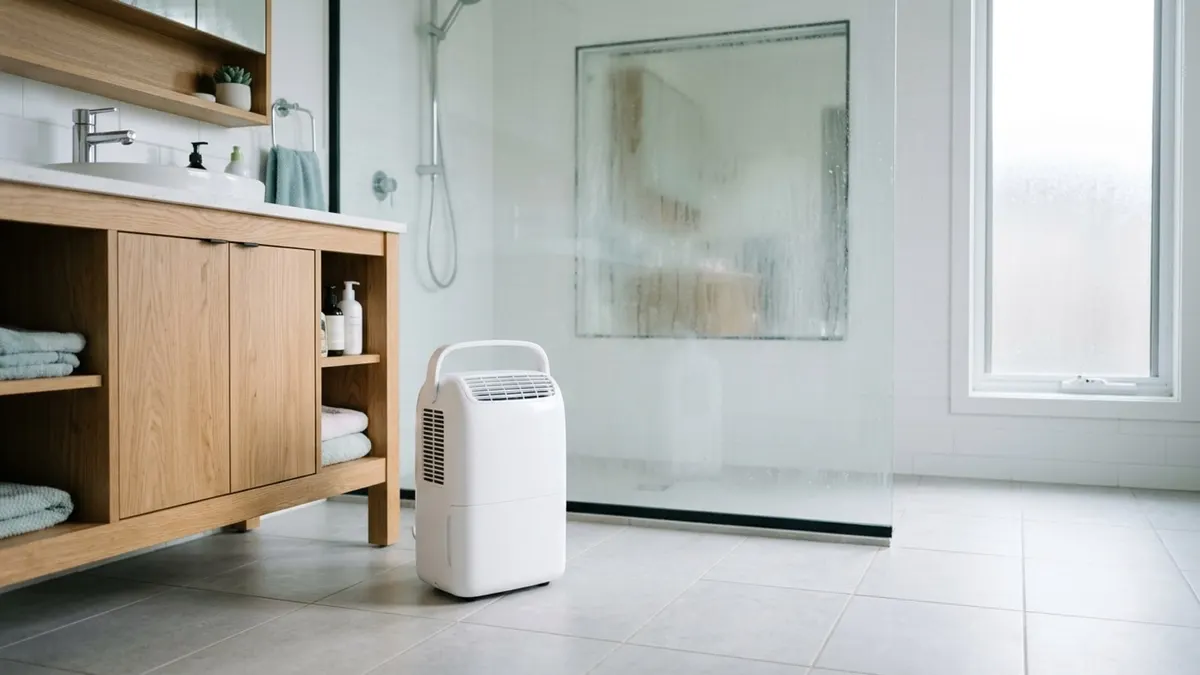
Cover image: Illustration: Indoor Air Review (AI-generated)
Related guides
Best Dehumidifiers for Basements: Pump, Drain Hose and Cold-Basement Picks
Six basement dehumidifiers chosen on ENERGY STAR's tested capacity, each maker's lowest operating temperature and where the water goes: pump, floor drain or bucket.

Best Dehumidifiers of 2026: Pump, Small-Room and Whole-Home Picks
Our top pick is the Midea Cube 50: a certified 49.67 pints a day at ENERGY STAR's 2.01 L/kWh, with a large bucket and a compact, extendable body. Here are six picks by job.

Crawl Space Dehumidifiers: When You Need One and Which to Buy
A sealed crawl space with a properly sized ENERGY STAR dehumidifier that drains on its own is the standard fix in humid climates. A bucket-type basement unit is usually the wrong tool. Here is why, and which three to buy.