
Best Dehumidifiers for Basements: Pump, Drain Hose and Cold-Basement Picks
The best dehumidifier for basement damp, picked on ENERGY STAR tested pints, the lowest temperature each one runs at, and pump or drain hose options.
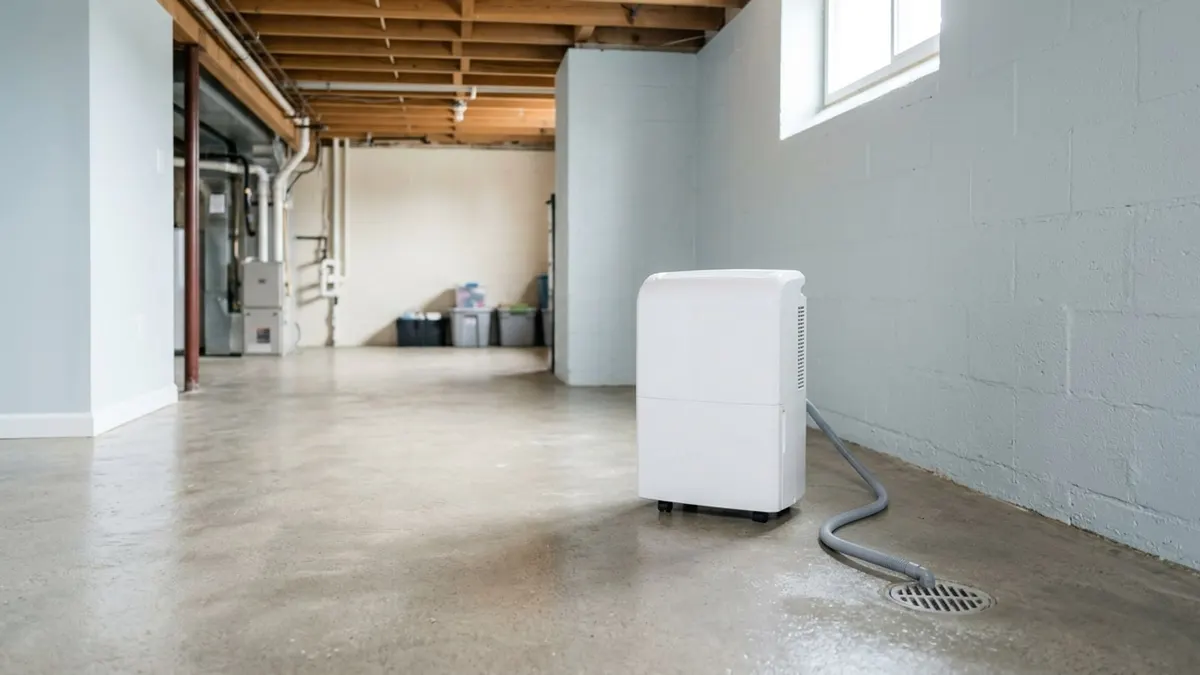
Affiliate disclosure: product links on this page go to Amazon, or to the maker's own store for brands that sell only direct. As an Amazon Associate we earn from qualifying purchases, at no extra cost to you; a link to a maker's store earns us nothing. No retailer or brand sees our picks before they are published or has any say in them. How we choose.
The best dehumidifier for most basements is the Hisense 50-Pint with Built-In Pump (ADH50KP26). ENERGY STAR's certified list puts it at 49.95 pints a day under the Department of Energy test, which runs at 65°F because that is close to a real basement. Its pump sends water up to a laundry sink or out a window, so a full bucket does not shut it off, and its listing rates it down to 38°F. It is sold by Amazon with a 2-year limited warranty (per the Amazon listing).
This guide is for damp or musty basements, finished or not. Each pick was chosen on three things a basement decides: ENERGY STAR's tested capacity (not the "max pints" in listing titles), the lowest temperature the maker says the unit runs at, and where the water goes. Not sure what size you need? Start with our basement dehumidifier sizing calculator.
Our top picks at a glance
1. Best overall for basements
Hisense 50-Pint Dehumidifier with Built-In Pump (ADH50KP26)DOE capacity: 49.95 pints/day · Lowest operating temp: 38°F (per the Amazon listing) · Drainage: Built-in pump, bucket · Annual energy: 526 kWh ($90.47)
2. Best with a floor drain
Midea 50-Pint Dehumidifier (MAD50C1AWS-A)DOE capacity: 49.74 pints/day · Lowest operating temp: 41°F (Midea manual) · Drainage: Gravity hose (not included), bucket · Annual energy: 525 kWh ($90.30)
3. Best for cold basements
AlorAir Sentinel HD55S Wi-Fi Crawl Space DehumidifierDOE capacity: 36.33 pints/day · Lowest operating temp: 33.8°F (AlorAir spec sheet) · Drainage: Gravity hose only · Annual energy: 379 kWh ($65.19)
4. Best pump unit with simple controls
Whirlpool 50-Pint Dehumidifier with Pump (WHHD501PAW)DOE capacity: 50.00 pints/day · Lowest operating temp: Not stated in Whirlpool's manual · Drainage: Pump (about 16.4 ft), gravity hose, bucket · Annual energy: 530 kWh ($91.16)
5. Best for a small or finished basement
Levoit 25-Pint Dehumidifier with Pump (LDH-H251S)DOE capacity: 24.54 pints/day · Lowest operating temp: Not on Levoit's product page · Drainage: Removable pump, gravity, garden hose, tank · Annual energy: 281 kWh ($48.33)
6. Best installed whole-basement unit
AprilAire E080 Whole-Home DehumidifierDOE capacity: 65.00 pints/day (whole-home rating) · Lowest operating temp: 50°F inlet air (AprilAire spec sheet) · Drainage: Drain line or condensate pump · Annual energy: 632 kWh ($108.70)
| Pick | DOE capacity | Lowest operating temp | Drainage | Annual energy | Buy |
|---|---|---|---|---|---|
| Hisense 50-Pint Dehumidifier with Built-In Pump (ADH50KP26)Best overall for basements | 49.95 pints/day | 38°F (per the Amazon listing) | Built-in pump, bucket | 526 kWh ($90.47) | Amazon |
| Midea 50-Pint Dehumidifier (MAD50C1AWS-A)Best with a floor drain | 49.74 pints/day | 41°F (Midea manual) | Gravity hose (not included), bucket | 525 kWh ($90.30) | Amazon |
| AlorAir Sentinel HD55S Wi-Fi Crawl Space DehumidifierBest for cold basements | 36.33 pints/day | 33.8°F (AlorAir spec sheet) | Gravity hose only | 379 kWh ($65.19) | Amazon |
| Whirlpool 50-Pint Dehumidifier with Pump (WHHD501PAW)Best pump unit with simple controls | 50.00 pints/day | Not stated in Whirlpool's manual | Pump (about 16.4 ft), gravity hose, bucket | 530 kWh ($91.16) | Amazon |
| Levoit 25-Pint Dehumidifier with Pump (LDH-H251S)Best for a small or finished basement | 24.54 pints/day | Not on Levoit's product page | Removable pump, gravity, garden hose, tank | 281 kWh ($48.33) | Amazon |
| AprilAire E080 Whole-Home DehumidifierBest installed whole-basement unit | 65.00 pints/day (whole-home rating) | 50°F inlet air (AprilAire spec sheet) | Drain line or condensate pump | 632 kWh ($108.70) | Amazon |
Best overall for basements
Hisense 50-Pint Dehumidifier with Built-In Pump (ADH50KP26)
For most basements with a laundry sink or window to drain to: a certified 49.95 pints a day, a built-in pump and a 38°F rating.
- DOE capacity
- 49.95 pints/day
- Lowest operating temp
- 38°F (per the Amazon listing)
- Drainage
- Built-in pump, bucket
- Annual energy
- 526 kWh ($90.47)
Pros
- Built-in pump with a quick-connect hose to a sink or window (per the Amazon listing)
- Rated down to 38°F, three degrees lower than Midea's manual allows for its 50-pint units
- 2-year limited warranty, against Midea's 1 year
Cons
- Hisense has no US product page or manual online for this exact model, so its pump lift is unpublished
- 2.01 L/kWh, the minimum for its size class; not on ENERGY STAR's Most Efficient list
- The listing mentions no app or Wi-Fi
The ADH50KP26 is a 2026 model: ENERGY STAR certified it on January 6, 2026 at 49.95 pints a day, 2.01 liters per kWh and an estimated 526 kWh a year. At the EIA's 2025 US average of 17.2 cents per kWh, that is $90.47 a year. The listing describes three modes (Auto, Continuous and Manual), three fan speeds and a pump that drains through an included quick-connect hose. It measures 15.1 by 10.7 by 24.8 inches and weighs 40.3 lb (per the Amazon listing).
This model has no page on Hisense's US site, but the 38°F figure matches Hisense's own documents for its siblings: the manual for the white lift-up version (ALDH50KP26) gives 38 to 90°F, and the spec sheet for its earlier pump model, the AHD5024KP1G, lists 38°F and a 16-foot maximum pump height. Hisense has not published a lift figure for the ADH50KP26 itself.
Skip it if a floor drain sits right beside the unit: the Midea below drains by gravity and adds app control. If your basement drops into the 30s, the AlorAir HD55S is rated colder.
Best with a floor drain
Midea 50-Pint Dehumidifier (MAD50C1AWS-A)
For basements with a floor drain or sump lower than the unit: a certified 49.74 pints a day, gravity draining and app control.
- DOE capacity
- 49.74 pints/day
- Lowest operating temp
- 41°F (Midea manual)
- Drainage
- Gravity hose (not included), bucket
- Annual energy
- 525 kWh ($90.30)
Pros
- Humidity set from 35 to 85% in 5% steps, per Midea's manual
- Wi-Fi control through the MSmartHome app
- 49 dBA on low (per the Amazon listing)
Cons
- No pump: the hose has to run level or downhill to the drain
- You supply the hose, one with a female threaded end, per the manual
- 1-year warranty
Midea's MAD manual covers this model and its pump twin. It says to place the unit where the temperature will not fall below 41°F, because the coils frost at lower temperatures, and to run the drain hose so its end is "level or sloping downwards". ENERGY STAR lists it at 49.74 pints a day, 2.01 L/kWh and 525 kWh a year ($90.30), almost identical to the Hisense. A gravity hose has no pump to clog, but it only works when the drain is lower than the outlet on the back of the unit.
Skip it if the nearest drain is a laundry sink or a window: the Midea 50-pint with pump (MAD50P1AWS-A) has the same ENERGY STAR rating, or buy the Hisense above. If you would rather empty a big bucket, the Midea Cube leads our best dehumidifiers list.
Best for cold basements
AlorAir Sentinel HD55S Wi-Fi Crawl Space Dehumidifier
For unheated basements that sit in the 30s and 40s: AlorAir rates it to run from 33.8°F, and it can be ducted into a finished room.
- DOE capacity
- 36.33 pints/day
- Lowest operating temp
- 33.8°F (AlorAir spec sheet)
- Drainage
- Gravity hose only
- Annual energy
- 379 kWh ($65.19)
Pros
- Lowest published operating temperature on this page: 33.8 to 104°F
- Optional duct flanges let it sit on the unfinished side and dry a finished room
- 2.08 L/kWh, the best efficiency of the portables here
Cons
- Gravity draining only: no pump and no bucket
- Lower certified capacity than the 50-pint picks: 36.33 pints a day
- AlorAir gives noise only as under 52 dBA
AlorAir's spec sheet says an auto-defrost system clears ice from the coil at the unit's minimum operating temperature of 33.8°F. ENERGY STAR certifies it at 36.33 pints a day and 2.08 L/kWh, with 379 kWh a year ($65.19). The listing title says "120 PPD" and AlorAir's sheet says 55 pints at 80°F and 60% humidity; each is measured under different conditions, which is why this guide compares only the DOE figure.
AlorAir's sheet also draws a layout for a part-finished basement: the unit sits in the unfinished area near a drain, a duct from its flange carries dry air into the finished room, and a passive return grille in the dividing wall lets air flow back. AlorAir sizes it for up to 1,300 square feet.
Skip it if you have no floor drain or sump lower than the unit. The listing gives a 6-year limited warranty with the first 2 years full coverage. It is also a pick in our crawl space dehumidifier guide.
Best pump unit with simple controls
Whirlpool 50-Pint Dehumidifier with Pump (WHHD501PAW)
For anyone who wants a pump and buttons, not an app: a certified 50.00 pints a day and a pump that lifts water about 16.4 feet.
- DOE capacity
- 50.00 pints/day
- Lowest operating temp
- Not stated in Whirlpool's manual
- Drainage
- Pump (about 16.4 ft), gravity hose, bucket
- Annual energy
- 530 kWh ($91.16)
Pros
- Pump hose of about 16.4 ft (5 m) included, and the same figure is the manual's maximum pump height
- A humidity light changes color with the room's humidity, per the manual
- Front bucket, casters and top handles (per the Amazon listing)
Cons
- No minimum operating temperature in the manual
- A gravity hose must be no longer than 3.2 ft, per the manual
- Highest yearly energy of the 50-pint picks: 530 kWh
Its manual's warranty section is headed "XLS Products warranty for Whirlpool dehumidifiers". ENERGY STAR certified it in September 2025 at 50.00 pints a day, 2.01 L/kWh and 530 kWh a year ($91.16). The manual gives three ways to drain it: the front bucket, a gravity hose to a floor drain, or the pump, which starts emptying when the internal bucket is almost full and lifts water up to about 16.4 feet.
The manual's cold-weather notes are brief: frost on the coils means the room is too cold, and the water left inside must be emptied before the room drops to 32°F. It gives no minimum operating temperature, so for a basement that runs in the 40s the Hisense and the AlorAir have better-documented ratings. Skip it if you want app control; buy it for a pump with a published lift figure.
Best for a small or finished basement
Levoit 25-Pint Dehumidifier with Pump (LDH-H251S)
For a finished basement or a mildly damp one: ENERGY STAR Most Efficient, quiet on low, and four ways to drain.
- DOE capacity
- 24.54 pints/day
- Lowest operating temp
- Not on Levoit's product page
- Drainage
- Removable pump, gravity, garden hose, tank
- Annual energy
- 281 kWh ($48.33)
Pros
- The only portable pick with ENERGY STAR's Most Efficient mark
- Levoit quotes operation as low as 42 dB
- Removable, washable pump lifts water up to 9.8 ft (per the Amazon listing)
Cons
- Half the certified capacity of the 50-pint picks
- Levoit's page lists auto-defrost but no lowest operating temperature
- App features need Levoit's VeSync app
Levoit's product page rates it at 25 pints a day under the DOE 2019 conditions (65°F and 60% humidity) and up to 84 pints at 104°F and 95% humidity. ENERGY STAR certified it in August 2026 at 24.54 pints, 1.88 L/kWh and 281 kWh a year ($48.33). Levoit also lists a MERV 11 filter, auto-defrost, auto-restart after a power cut, VeSync app control and four drain options: pump, hose, gravity or tank.
Size is the trade-off. ENERGY STAR's chart puts a mildly damp space under 2,000 square feet at 20 to 30 pints a day, which this covers, so it suits a finished family room or basement office that only feels damp in summer. Skip it if the basement smells musty all year or has damp spots on the walls: that is ENERGY STAR's "very damp" band, so buy a 50-pint pick. Levoit's page lists a 2-year limited warranty; the Amazon listing adds a 3-year compressor warranty.
Best installed whole-basement unit
AprilAire E080 Whole-Home Dehumidifier
For a large, heated basement where you want the unit out of sight: ducted or hung from the joists, and Most Efficient.
- DOE capacity
- 65.00 pints/day (whole-home rating)
- Lowest operating temp
- 50°F inlet air (AprilAire spec sheet)
- Drainage
- Drain line or condensate pump
- Annual energy
- 632 kWh ($108.70)
Pros
- ENERGY STAR Most Efficient at 2.35 L/kWh
- 45 dBA when ducted, per AprilAire
- Ships with a condensate pump and hanging kit (per the Amazon listing)
Cons
- Dehumidifies only with inlet air from 50 to 104°F and a 40°F minimum dew point
- Needs an install: ENERGY STAR advises a contractor
- Highest yearly energy here: 632 kWh
AprilAire's spec sheet rates the E080 at 80 pints a day at 80°F and 60% humidity and 65 pints at 73°F and 60%, the figure ENERGY STAR lists for it as a whole-home unit. It moves up to 185 CFM, draws 4.8 amps and weighs 63 lb. With AprilAire's 5546 duct kit it can sit in a mechanical room or unfinished corner and dry a finished space through grilles.
The catch for basements is temperature. AprilAire rates dehumidification only for inlet air from 50 to 104°F with a dew point of at least 40°F, and gives a separate, wider range of 40 to 140°F for its ventilation mode. A heated, finished basement fits. An unheated one that sits in the 40s through winter is a job for the AlorAir. AprilAire's sheet gives a 5-year warranty; the listing describes "5-year full replacement plus 1-year parts".
Skip it unless you are ready for an install. ENERGY STAR suggests hiring a contractor to size and install a whole-home unit, with its drainage routed to a floor drain or condensate pump by an HVAC professional. AprilAire's 4856 condensate pump lifts 22 feet.
How we chose basement dehumidifiers
- Certified capacity. Pints per day from ENERGY STAR's certified data, measured to the DOE test at 65°F, which ENERGY STAR says better reflects a basement.
- The lowest temperature the maker publishes. ENERGY STAR warns that frost can form on the coils below 65°F and suggests a unit specified for lower temperatures if your space runs cooler.
- Drainage. Pump lift, gravity hose or bucket, from the manual where there is one.
- Running cost. ENERGY STAR's estimated kWh a year at the EIA's 2025 US average of 17.2 cents per kWh.
Basement buying guide
Size it by dampness, not just square feet
ENERGY STAR sizes portable units by how damp the space is before you start. The figures below are minimum pints per day, and ENERGY STAR says it is better to oversize than undersize.
| How the basement feels | Under 2,000 sq ft | Over 2,000 sq ft |
|---|---|---|
| Slightly to moderately damp: a musty smell now and then (50 to 75% RH) | 20 to 30 | 30+ |
| Very damp: always smells damp, damp spots on walls and floors (75 to 90% RH) | 25 to 40 | 40+ |
| Wet: walls or floor sweat, seepage, laundry drying (90 to 100% RH) | 30 to 50 | 50+ |
Any 50-pint pick covers all three rows under 2,000 square feet; the Levoit fits the first. If you are replacing an old unit, remember the 2019 test change: ENERGY STAR's conversion table says an old 50-pint rating is about a new 30, and an old 70 about a new 40 to 45. Our sizing calculator works it out for your floor area.
Cold basements: check the operating temperature
A compressor dehumidifier chills air over a coil. In a cool basement that coil can frost, and ENERGY STAR says the compressor may then cycle on and off without removing moisture. Here is what each maker publishes:
| Model | Runs from | Up to | Source |
|---|---|---|---|
| AlorAir Sentinel HD55S | 33.8°F | 104°F | AlorAir spec sheet |
| AlorAir Helios D35 | 37.4°F | 100.4°F | AlorAir spec sheet |
| Hisense ADH50KP26 | 38°F | Not stated | Amazon listing (Hisense's ALDH50KP26 manual: 38 to 90°F) |
| Midea MAD50C1AWS-A | 41°F | 90°F | Midea manual |
| AprilAire E080 | 50°F inlet air, 40°F dew point | 104°F | AprilAire spec sheet |
| Whirlpool WHHD501PAW | Not stated | Not stated | Whirlpool manual |
| Levoit LDH-H251S | Not stated | Not stated | Levoit product page |
The AlorAir Helios D35 is a smaller gravity-drain option for a cold space: ENERGY STAR lists it at 24.00 pints a day with the Most Efficient mark, and AlorAir's sheet gives a 6.5-foot drain hose. Every unit also adds a little heat: Hisense's manual says the room may warm by about 6°F, depending on its size.
Floor drain, pump or bucket
Draining decides whether a basement dehumidifier keeps working. When a bucket fills, the unit stops and the basement gets damp again. Match the unit to where the water can go:
| Where the water can go | What you need | Picks |
|---|---|---|
| Floor drain or sump lower than the unit's outlet | Gravity hose | Midea MAD50C1AWS-A, AlorAir HD55S, or any pump unit in hose mode |
| Laundry sink, window or drain above the unit | Built-in pump; check its lift | Hisense ADH50KP26, Whirlpool WHHD501PAW (about 16.4 ft), Levoit LDH-H251S (9.8 ft, per the listing) |
| Nowhere nearby | A big bucket, emptied daily | Midea Cube (4.2-gallon bucket, per the listing) |
| Ducted or hung from the joists | Drain line or condensate pump | AprilAire E080 (AprilAire's 4856 pump lifts 22 ft) |
ENERGY STAR's rules for the hose apply to all of them: never set up water drainage near electrical circuits or devices, keep drain hoses away from cords, and plug the unit into a grounded outlet.
Efficiency and running cost
ENERGY STAR Version 6.0, in effect since October 1, 2025, sets minimum efficiency for portables by size: 1.70 L/kWh up to 25 pints a day, 2.01 from 25.01 to 50, and 3.30 above 50. Whole-home units with a case of 8.0 cubic feet or less need 2.22. In ENERGY STAR's data, every 45-to-50-pint portable from Amana, BLACK+DECKER, Danby, Frigidaire, GE, Hisense, Honeywell, LG, Midea and Whirlpool sits at 2.01 to 2.08 L/kWh, and none carries the Most Efficient mark; the few that do come from smaller brands. Of the picks here, only the Levoit and the AprilAire have it.
The yearly costs in the picks table are ENERGY STAR's estimated kWh times 17.2 cents. For a ranking by efficiency, see energy-efficient dehumidifiers.
Finished or unfinished basement
In a finished basement, noise matters more. The quietest published figures for these picks: Levoit, as low as 42 dB; AprilAire E080, 45 dBA ducted; Whirlpool, as low as 45 dBA (per the Amazon listing); Midea, 49 dBA on low (per the Amazon listing); AlorAir HD55S, under 52 dBA. The makers do not say how or where they measured, so treat a gap of a few decibels as a tie. Hisense publishes no figure for the ADH50KP26.
In an unfinished basement, put the unit near its drain and keep the windows and outside doors closed while it runs, as ENERGY STAR advises. Units without top discharge need room around them: Midea asks for 8 inches on every side and 16 in front of the outlet. ENERGY STAR also says to keep it away from dust sources such as woodworking equipment, which can clog coils.
Fix the water before you buy
EPA's mold guidance starts with one line: "The key to mold control is moisture control." A dehumidifier controls humidity; it does not stop water coming in. EPA advises keeping indoor humidity below 60%, ideally 30 to 50%, and drying any water-damaged area within 24 to 48 hours.
ENERGY STAR's list for basements: extend downspouts away from the foundation, keep gutters clear, make sure the soil slopes away from the house, and vent the clothes dryer outdoors. EPA adds: insulate cold water pipes so they stop sweating. A dehumidifier will not remove mold that is already growing; EPA says to clean it up and fix the water problem. Our guide to the humidity level that prevents mold covers the targets.
What to skip
- "Max pints" in titles. The AlorAir HD55S listing title says 120 PPD; ENERGY STAR's figure is 36.33. Levoit's own page puts 84 pints at 104°F and 95% humidity next to its 25-pint DOE rating. Compare DOE figures only.
- Square footage alone. The listings for the 25-pint Levoit and the 50-pint Midea both say 4,500 square feet. Use ENERGY STAR's dampness chart instead.
- A "Most Efficient" badge you cannot match. Check the listing's model number against ENERGY STAR's certified list before you trust it.
- An installed unit in a cold basement. AprilAire rates the E080 to dehumidify only with inlet air of 50°F or warmer.
- An air purifier instead of a dehumidifier. A purifier filters dust and some odors; it does not lower humidity. See air purifiers for basements for that job.
Frequently asked questions
What size dehumidifier do I need for my basement?
ENERGY STAR sizes it by dampness. Under 2,000 square feet, a basement with an occasional musty smell needs 20 to 30 pints a day, one that always smells damp needs 25 to 40, and one with sweating walls or seepage needs 30 to 50. ENERGY STAR says it is better to oversize than undersize, so a 50-pint unit covers most basements.
What humidity should my basement be?
EPA advises keeping indoor humidity below 60%, ideally 30 to 50%, and ENERGY STAR gives the same 30 to 50% range. In cold climates during the heating season, ENERGY STAR suggests 30 to 40% to prevent window condensation. A hygrometer tells you where you stand.
Will a dehumidifier work in a cold basement?
Capacity drops as the air cools, and ENERGY STAR says frost can form on the coils below 65°F. Check the maker's lowest operating temperature: AlorAir rates the Sentinel HD55S from 33.8°F, the Hisense ADH50KP26 listing says 38°F, and Midea's manual says 41°F. Below those figures, expect defrost cycles or shutdowns.
Do I need a dehumidifier with a pump in my basement?
Only if the water has to go up. A floor drain or sump lower than the unit works with a plain gravity hose. If the nearest drain is a laundry sink or a window, you need a pump: Whirlpool's manual gives about 16.4 feet of lift for the WHHD501PAW.
How much does it cost to run a dehumidifier in a basement?
ENERGY STAR estimates 525 to 530 kWh a year for the 50-pint picks here, which is $90.30 to $91.16 at the EIA's 2025 US average of 17.2 cents per kWh. The 25-pint Levoit is 281 kWh, or $48.33. Your cost depends on how many hours the unit runs and your local rate.
Where should I put a dehumidifier in my basement?
Near the drain or sink it will empty into, on a level floor, away from walls unless it blows air out the top, and away from dust sources such as a workbench. Keep the basement's windows and outside doors closed while it runs, and keep hoses away from electrical cords, as ENERGY STAR advises.
Sources
- Dehumidifiers, ENERGY STAR (US EPA)
- Dehumidifier Testing and Capacity, ENERGY STAR (US EPA)
- Dehumidifiers Key Efficiency Criteria, ENERGY STAR (US EPA)
- ENERGY STAR Certified Dehumidifiers (data set), ENERGY STAR (US EPA)
- A Brief Guide to Mold, Moisture and Your Home, US Environmental Protection Agency
- Sentinel HD55S Wi-Fi Dehumidifier specification sheet, AlorAir
- Model E080 Dehumidifier Specification (copy hosted by Green Building Advisor), AprilAire
- Dehumidifier WHHD501PAW owner's manual (W11740392A; copy hosted by Sylvane), XLS Products for Whirlpool
- Dehumidifier MAD user manual (MAD22C1AWS, MAD35C1AWS, MAD50C1AWS, MAD50P1AWS; copy hosted by Sylvane), Midea
- Use and Installation Manual, Model ALDH50KP26 (copy hosted by Sylvane), Hisense
Cover image: Illustration: Indoor Air Review (AI-generated)
Related guides

Best Dehumidifiers of 2026: Pump, Small-Room and Whole-Home Picks
Our top pick is the Midea Cube 50: a certified 49.67 pints a day at ENERGY STAR's 2.01 L/kWh, with a large bucket and a compact, extendable body. Here are six picks by job.

Crawl Space Dehumidifiers: When You Need One and Which to Buy
A sealed crawl space with a properly sized ENERGY STAR dehumidifier that drains on its own is the standard fix in humid climates. A bucket-type basement unit is usually the wrong tool. Here is why, and which three to buy.

Dehumidifier vs Air Conditioner: Which One Fixes a Humid House?
Air conditioning dries the air as a side effect of cooling. In damp basements and mild, muggy weather it does little; a dehumidifier does the job. In humid summers, many homes need both.