
Air Purifier vs Humidifier: What Each Does and Which You Need
Air purifier vs humidifier: one removes particles, the other adds moisture. See which problem you have, how to run both, and which combos carry AHAM ratings.
Affiliate disclosure: product links on this page go to Amazon, or to the maker's own store for brands that sell only direct. As an Amazon Associate we earn from qualifying purchases, at no extra cost to you; a link to a maker's store earns us nothing. No retailer or brand sees our picks before they are published or has any say in them. How we choose.
An air purifier removes particles such as dust, pollen, pet dander and smoke from one room's air; a humidifier adds water vapor to it. Neither does the other's job. EPA describes portable air cleaners as filters for particles (and, with a carbon filter, some gases), and it tells humidifier owners not to push indoor humidity above 50 percent. So measure before you buy: if a heated home reads below EPA's 30 to 50 percent range on a hygrometer, you need a humidifier; if the complaint is dust, pets, pollen or smoke, you need a purifier. Plenty of homes need both in winter.
Our pairing for a living room or large bedroom is the Levoit Core 400S-P purifier (AHAM smoke CADR 234 cfm, for rooms up to 363 sq ft) and the Vornado EVDC500 evaporative humidifier (rated by Vornado at 3.5 gallons a day). If you want one box, the Blueair 2-in-1 Pro DH5i has the highest AHAM rating of the combos on this page: 252 cfm for smoke, for 391 sq ft. Everything below comes from EPA, CARB, the AHAM directory, two peer-reviewed studies and the makers' own documents.
Air purifier vs humidifier at a glance
| Air purifier | Humidifier | |
|---|---|---|
| What it changes | Removes airborne particles; a carbon filter also takes some gases and odors | Adds water vapor, raising relative humidity |
| What it leaves alone | Humidity, the moisture behind mold, carbon dioxide | Dust, pollen, pet dander, smoke and odors |
| Number to shop by | AHAM smoke CADR against room size (EPA: at least 65 cfm per 100 sq ft with an 8-foot ceiling) | Gallons of output a day and the maker's rated room size |
| Ongoing cost | Replacement filters (Levoit lists the Core 400S-P filter at $49.99) | Wicks for evaporative units (Vornado lists a 2-pack for the EVDC500 at $14.99), or distilled water for ultrasonic units |
| What goes wrong | Too small for the room; a filter left past its life | Humidity over 50 percent; a dirty tank; white mineral dust from an ultrasonic unit on tap water |
| Who it suits | Homes with pets, pollen, dust or smoke | Heated homes with dry air in winter |
What an air purifier does
An air purifier, which EPA calls a portable air cleaner, pulls room air through filters and blows it back out. EPA's Guide to Air Cleaners in the Home says portable units are "designed to filter the air in a single room or area" and that most filters are built for either particles or gases. A HEPA-type filter handles particles; an activated carbon filter handles some gases and odors. EPA adds that air cleaners "cannot remove all pollutants from the air".
The number that sizes an air purifier is the clean air delivery rate (CADR), which EPA notes "is for particles only". Of the three CADR figures on the box, EPA says to choose a high tobacco smoke CADR to remove the smallest particles. Its sizing chart, for 8-foot ceilings, asks for at least 65 cfm for 100 sq ft, 130 for 200, 195 for 300, 260 for 400, 325 for 500 and 390 for 600.
What an air purifier does not do matters just as much here. It does not add or remove water vapor, so it will not fix dry air or damp air. EPA is plain about mold: portable air cleaners "do not address the cause of mold and musty odors", because mold grows from a water or moisture problem. A purifier does nothing for carbon dioxide or carbon monoxide either.
The Levoit Core 400S-P is the purifier we would pair with a humidifier. The AHAM Verifide directory rates it at 234 cfm for smoke, 233 for dust and 257 for pollen, for rooms up to 363 sq ft, which clears EPA's chart for a 300 sq ft room with room to spare. It has a laser particle sensor and an Auto Mode, and CARB lists the Core 400S as a mechanical (filter-only) air cleaner under EO G-21-166. For other rooms and budgets, see our best air purifiers.
What a humidifier does
A humidifier adds water vapor to dry indoor air. EPA's Use and Care of Home Humidifiers says people use them to relieve the discomforts of a "dry nose, throat, lips, and skin", and that the added moisture also helps with static electricity, peeling wallpaper and cracks in paint and furniture during the heating season. A humidifier does nothing about particles, pollen or smoke already in the room.
The limit is at the top end. EPA says: "Do not humidify to indoor relative humidity levels exceeding 50 percent," because higher levels may encourage the growth of dust mites and mold. EPA's mold guide puts the ideal range at 30 to 50 percent and the ceiling at 60. MedlinePlus advises setting a humidifier to 40 to 50 percent. A hygrometer, which EPA prices at $10 to $50, tells you where you stand; our guide to the ideal indoor humidity level covers the numbers season by season.
The humidifier type matters to anyone who also runs a purifier. EPA says ultrasonic and impeller ("cool mist") humidifiers can disperse minerals and microorganisms from the tank into the air, while evaporative units and steam vaporizers "are not expected to disperse substantial amounts of minerals". Our ultrasonic vs evaporative comparison covers the rest of the trade-offs.
That is why our humidifier pick is evaporative. The Vornado EVDC500 blows air through a wet wick, so it puts out no visible mist. Vornado rates it at 3.5 gallons of output in 24 hours and coverage up to 840 sq ft, from two 1-gallon tanks, with an electronic humidistat that lets you cap the humidity. For smaller rooms and other types, see our best humidifiers.
Which one do you need?
Start with what you notice, then measure. For humidity, EPA's ranges make the call; for particles, the sources in your home do.
| What you notice | What to check | What to buy |
|---|---|---|
| Static shocks, a dry nose or lips, cracking paint or wood trim in winter | A hygrometer below 30 percent | Humidifier |
| Dust settling fast, pet dander, pollen season | Humidity already within 30 to 50 percent | Air purifier |
| Wildfire smoke or cooking smoke indoors | Room size against the purifier's smoke CADR | Air purifier |
| Dry winter air plus pets or pollen | A hygrometer below 30 percent and a particle source | Both, as two machines or a combo |
| Condensation on windows, a damp or musty smell | A hygrometer above 50 to 60 percent | Neither: find the moisture source, then consider a dehumidifier |
Our checklist of signs your home is too dry goes through the dry-air symptoms one by one. If a musty smell is the problem, an air purifier is not the fix: EPA says the moisture source has to go and the mold has to be cleaned up.
Running an air purifier and a humidifier in the same room
Running an air purifier and a humidifier together is common in winter, and it works if each one stays in its lane. The rules come from EPA and from the purifier makers' own manuals:
- Keep humidity at 30 to 50 percent. EPA's ceiling for humidifier users is 50 percent. If water condenses on windows, walls or pictures, EPA says to move the humidifier, lower its setting or run it less.
- Keep the water away from the purifier. Levoit's Core 400S-P manual says to keep the purifier "away from water, and wet or damp areas", to run it below 85 percent relative humidity, and warns that in very humid areas "the surface of the filter may become moldy". Aim the humidifier's output away from the purifier's air intake.
- Choose evaporative, or use distilled water in an ultrasonic unit. EPA recommends water with low mineral content, such as distilled water, to avoid releasing minerals into the air.
- Clean the humidifier on schedule. EPA says to empty, wipe dry and refill a portable humidifier daily and to clean it every third day; MedlinePlus says to drain and clean it daily. Follow your model's manual for products and wicks.
Ultrasonic mist shows up as particles
An ultrasonic humidifier running on tap water is a particle source of its own. A Virginia Tech team ran a 3-liter ultrasonic humidifier for 8 hours in a typical bedroom (Sain and colleagues, Indoor Air, 2018) and measured 30,100 to 59,100 airborne particles per cubic centimeter, with the most common sizes between 109 and 322 nanometers. That is 0.1 to 0.3 microns, far below the 2.5-micron cutoff for PM2.5. The particles carried the same minerals as the fill water, and water with fewer minerals produced fewer, smaller particles.
Levoit's manual describes the effect on a purifier's sensor: with an ultrasonic humidifier nearby, the sensor "will detect the large mist particles, and the Air Quality Indicator may turn red." Levoit's advice is to avoid using an ultrasonic humidifier near the purifier, or to avoid Auto Mode. An evaporative humidifier sidesteps the problem, which is why we pair the purifier with the Vornado.
Too much humidity works against an allergy purifier
Humidity, not filtration, is what keeps dust mites down. An air purifier can only filter what is in the air, while mites live in household dust. In a study of homes in a humid, temperate climate (Arlian and colleagues, Journal of Allergy and Clinical Immunology, 2001), houses held below 51 percent relative humidity for 17 months went from 401 to 8 live mites per gram of dust, and their mite allergen ended up more than 10 times lower than in the humid homes. EPA's humidifier page makes the same link: excess moisture can encourage dust mites and mold. If you run a humidifier for dry air and a purifier for allergies, the humidistat decides whether one undoes the other, so keep it at or below 50 percent.
Air purifier and humidifier combos
A combo unit puts a particle filter and a humidifier in one housing. It makes sense when floor space is short, or when one room, often a bedroom, needs both. Judge a combo as a purifier first: an AHAM Verifide smoke CADR that fits the room, and a place on CARB's list of certified air cleaners. CARB's list marks each device "Mechanical" (physical filtration only, no ozone or ions) or "Electronic" (ionizers, UV lamps and similar stages, tested to an ozone limit of 0.050 ppm). Then check the humidifier type and what the filters and wicks cost.
| Combo | AHAM smoke / dust / pollen CADR | AHAM room size | CARB listing | Humidifier |
|---|---|---|---|---|
| Blueair 2-in-1 Pro DH5i (6531511000) | 252 / 276 / 310 cfm | 391 sq ft | G-25-271, Electronic | Washable wick, up to 60 hours a fill (per the Amazon listing) |
| Sharp KC-850U | 169 / 178 / 202 cfm | 262 sq ft | G-10-054, Electronic | Natural vaporization, 7.7-pint tank (Sharp) |
| Dyson Purifier Humidify+Cool PH2 De-NOx (PH05) | Not in the directory | Not rated | G-24-262, Electronic | 1-gallon tank, up to 36 hours, UV-treated water (Dyson) |
| Homedics AP-H400 | Not in the directory | Not rated | G-24-180, Mechanical | Evaporative, no visible mist (per the Amazon listing) |
Blueair DH5i: the combo with the highest AHAM rating here
The Blueair 2-in-1 Pro DH5i is the combo to buy if you want one box. CARB lists the 2-in-1 Pro DH5i as model 6531511000, and the AHAM directory rates that model at 252 cfm for smoke, 276 for dust and 310 for pollen, for rooms up to 391 sq ft. Its smoke CADR is higher than the Levoit's 234, so the purifier half gives up nothing to a good standalone unit. The listing describes a machine-washable wick, up to 60 hours per fill and a particle and carbon filter rated for up to 9 months (all per the Amazon listing).
Skip the DH5i if you need to humidify a large open-plan floor. We found no gallons-per-day output figure for it, so the humidifier half cannot be sized the way the Vornado's can, and a separate humidifier can sit where the dry air is.
Sharp KC-850U: long-standing ratings, older design
The Sharp KC-850U has been on CARB's list since 2010, and the AHAM directory rates it at 169 cfm for smoke, 178 for dust and 202 for pollen, for rooms up to 262 sq ft. Sharp's specification sheet lists a natural-vaporization humidifier with a 7.7-pint tank, a humidification filter that lasts up to 2 years, HEPA and deodorizing filters that last up to 5 years depending on use and room conditions, and a 1-year parts and labor warranty. It also runs Sharp's Plasmacluster ion generator, which the sheet says can be switched on or off; that stage is why CARB lists it as Electronic.
The sheet is dated 2009, so this is an old design with a smaller CADR than the Blueair. Buy it for a bedroom of about 250 sq ft and for the long filter life; skip it for anything larger.
Dyson PH2 De-NOx: no CADR to compare
The Dyson Purifier Humidify+Cool PH2 De-NOx is also a fan. Dyson's product page lists a 1-gallon tank good for up to 36 hours, water passed under a 275-nanometer UV light that Dyson says kills 99.9% of bacteria in the water, a combined HEPA and K-Carbon filter to replace every 12 months at 12 hours a day, 90 degrees of oscillation and a 2-year limited warranty, at a list price of $899.99. It is on CARB's list (model PH05, G-24-262), but the AHAM directory lists no Dyson models, so there is no smoke CADR to set against a room size. Buy it for the fan and the design, not for published air-cleaning figures.
Homedics AP-H400: small rooms only
The Homedics AP-H400 is the low-cost way to get both in one box, and CARB lists it as a mechanical air cleaner (G-24-180). It is not in the AHAM directory. Its listing says it "purifies the air in an 86 sq. ft. room 4.8 times per hour" (per the Amazon listing). Assuming an 8-foot ceiling, our arithmetic puts that at about 55 cfm of clean air (86 x 8 x 4.8 / 60), below the 65 cfm EPA's chart asks for in a 100 sq ft room. Treat it as a unit for a room under 100 sq ft.
Two machines or one: the trade-offs
- Sizing. Two machines can each be sized for their job: CADR for the purifier, gallons a day for the humidifier. A combo's halves come as a set.
- Placement. EPA's fix for condensation is to move the humidifier or turn it down. With a combo, the purifier moves too.
- Upkeep. A combo still has both chores: the purifier filter on its schedule, and a tank and wick that EPA says to clean every third day.
- Space. One footprint and one plug. In a small bedroom, that can decide it.
Our verdict
Buy for the problem you can measure. Dry winter air calls for a humidifier; dust, pollen, pets or smoke call for an air purifier; both problems call for two machines across the room from each other, such as the Levoit Core 400S-P and the Vornado EVDC500, with the humidistat at or below 50 percent. If floor space rules that out, the Blueair DH5i is the combo whose purifier half matches a good standalone unit on AHAM's numbers. Skip combos for large open-plan rooms and for wildfire smoke in a big space, where a dedicated purifier gives you the most CADR for the money.
Frequently asked questions
What is the difference between an air purifier and a humidifier?
An air purifier filters particles such as dust, pollen, pet dander and smoke out of a room's air, and with a carbon filter some gases and odors. A humidifier adds water vapor to raise relative humidity. A purifier does not change humidity, and a humidifier does not clean the air, so EPA's guidance treats them as two separate jobs.
Is an air purifier the same as a humidifier?
No. Both have a fan, but a purifier's filter traps particles while a humidifier's wick or tank puts water into the air. Combo units put both in one housing, such as the Blueair 2-in-1 Pro DH5i and the Sharp KC-850U, and each half still needs its own upkeep.
Is a humidifier or an air purifier better for allergies?
For airborne allergens such as pollen and pet dander, the air purifier is the device that removes them. EPA says studies with portable HEPA air cleaners have found improvements in one or more allergy or asthma symptoms, though not major improvements in every case. A humidifier removes no allergens, and EPA warns that humidity above 50 percent may encourage dust mites and mold.
Can I run an air purifier and a humidifier in the same room?
Yes. Keep humidity between 30 and 50 percent, aim the humidifier's output away from the purifier, and use an evaporative humidifier or distilled water in an ultrasonic one. Levoit's Core 400S-P manual says mist from a nearby ultrasonic humidifier can turn its air quality light red, and advises keeping the two apart or not using Auto Mode.
Does an air purifier dry out the air?
No. An air purifier moves air through filters that catch particles and, with carbon, some gases; it does not add or remove water vapor. If a room feels dry with a purifier running, check a hygrometer against EPA's 30 to 50 percent range and add a humidifier only if the reading is low.
Are air purifier and humidifier combos worth it?
They are worth it when space is tight and the combo carries an AHAM Verifide CADR big enough for the room. Of the combos we checked, the Blueair DH5i (252 cfm smoke CADR, 391 sq ft) and the Sharp KC-850U (169 cfm, 262 sq ft) are in the AHAM directory; the Dyson PH2 De-NOx and the Homedics AP-H400 are not. For large rooms or smoke, two separate machines give you more control.
Should I get a humidifier or an air purifier for a baby's room?
Measure first: a humidifier answers dry air and a purifier answers dust, dander or smoke. For humidifiers, MedlinePlus says to always use a cool-mist unit, especially for children, because warm-mist humidifiers can cause burns, and to set it to 40 to 50 percent humidity. Keep the humidifier's output away from any purifier and clean the tank as the maker directs.
Sources
- Guide to Air Cleaners in the Home, 2nd edition, US Environmental Protection Agency
- Use and Care of Home Humidifiers, US Environmental Protection Agency
- A Brief Guide to Mold, Moisture and Your Home, US Environmental Protection Agency
- Humidifiers and health, MedlinePlus, US National Library of Medicine
- Size and mineral composition of airborne particles generated by an ultrasonic humidifier (Indoor Air, 2018), Sain, Zook, Davy, Marr and Dietrich, Virginia Tech
- Reducing relative humidity is a practical way to control dust mites and their allergens in homes in temperate climates (J Allergy Clin Immunol, 2001), Arlian and colleagues, Wright State University
- List of CARB-Certified Air Cleaning Devices, California Air Resources Board
- AHAM Verifide Directory: Certified Room Air Cleaners (Levoit Core 400S-P, Blueair 6531511000, Sharp KC-850U), Association of Home Appliance Manufacturers
- Core 400S-P Smart Air Purifier user manual, Levoit
- Dyson Purifier Humidify+Cool PH2 De-NOx, Dyson
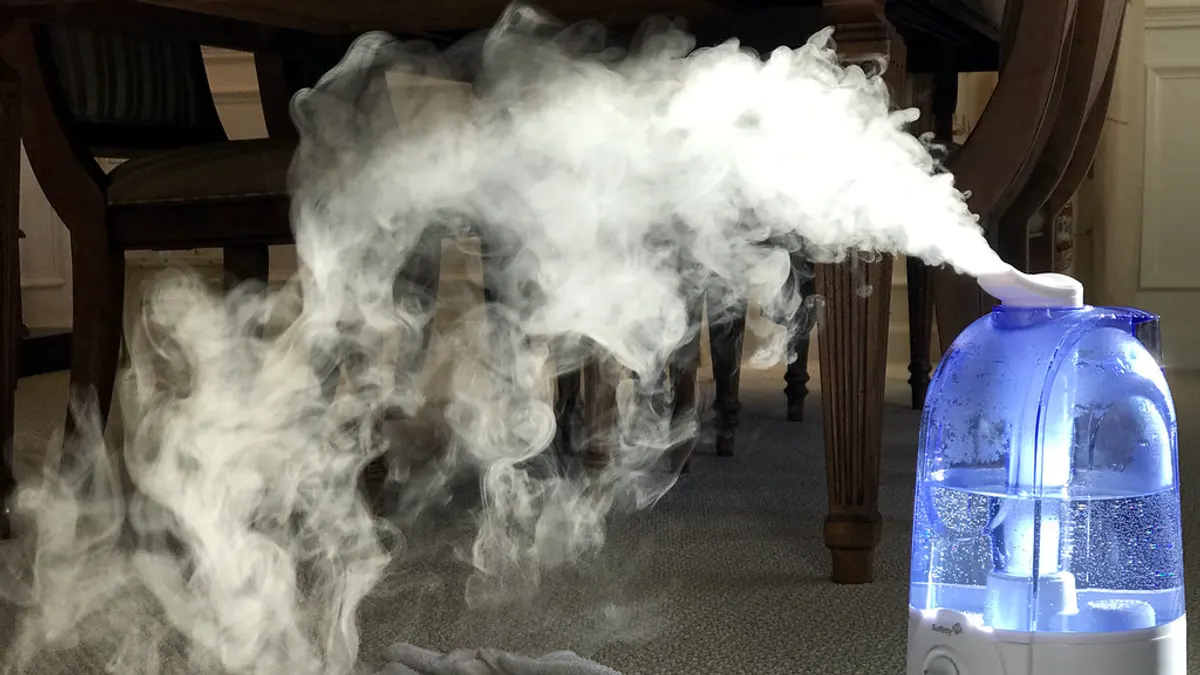
Cover photo: Humidifier Action by byzantiumbooks, CC BY 2.0, via Flickr. Cropped.
Related guides

Alen BreatheSmart 45i Review: Strong Mid-Size Purifier, Strings Attached
The 45i is Alen's mid-size purifier: a strong claimed CADR, a choice of filters for different problems, and a lifetime warranty that only lasts as long as your filter subscription.

Alen BreatheSmart 75i Review: Big-Room Purifier, Big-Room Price
The 75i is Alen's large-room machine, built for open plan spaces up to about 540 sq ft at allergy-level air changes. It is quiet and efficient, but its CADR is Alen's own and it costs more than certified rivals.

Austin Air HealthMate Plus Review: For Smoke, VOCs and Chemical Sensitivity
The HealthMate Plus is the chemical-focused version of Austin Air's HealthMate: the same heavy steel body, with an impregnated carbon blend aimed at formaldehyde, VOCs, wildfire smoke odor and traffic fumes.